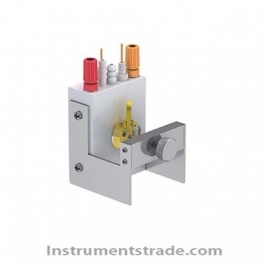
CS350M Electrochemical Workstation

Product ID:FDgzz024

Price: US$6,880.00 ~ US$7,980.00 PDF Format
Supply Ability:50 SETS/MON
Port:SHENZHEN
  • Product Introduction
  • Other information
  • Model NumberCS350M
    Brand NameKESITE
    Payment TermsTT,PAYPAL,Alibaba.com Pay
     
    CS350M Electrochemical Workstation
    High-Precision Potentiostat/Galvanostat for Advanced Electrochemical Research
    Overview
    The CS350M Electrochemical Workstation is a high-performance electrochemical analysis system designed for researchers and laboratories working in battery technology, fuel cells, corrosion studies, electrochemical sensors, materials science, and environmental analysis. Featuring a fully floating-ground architecture, integrated frequency response analysis (FRA), and ultra-high measurement sensitivity, the CS350M delivers reliable and accurate electrochemical testing results.
    Its advanced hardware design, combined with powerful software, provides a comprehensive platform for electrochemical characterization, impedance spectroscopy, corrosion evaluation, and energy storage research.

    Key Benefits
    ✔ High stability floating-ground design for accurate measurements
    ✔ Built-in FRA (Frequency Response Analyzer) from 10 μHz to 1 MHz
    ✔ High-power potentiostat, galvanostat, and zero-resistance ammeter (ZRA)
    ✔ Wide voltage range up to ±10 V and cell voltage up to ±21 V
    ✔ Current measurement sensitivity down to 1 pA (extendable to 100 fA)
    ✔ Fast data acquisition with high-resolution ADC technology
    ✔ Automatic current and potential range switching
    ✔ Suitable for batteries, fuel cells, supercapacitors, corrosion studies, and electrochemical sensors

    Typical Applications
    Energy Storage & Battery Research
      •Lithium-ion battery testing
      •Sodium-ion battery research
      •Solid-state battery characterization
      •Fuel cell performance evaluation
      •Supercapacitor analysis
      •Solar cell and photovoltaic material studies
    Electrochemical Analysis
      •Cyclic Voltammetry (CV)
      •Linear Sweep Voltammetry (LSV)
      •Differential Pulse Voltammetry (DPV)
      •Square Wave Voltammetry (SWV)
      •Chronoamperometry (CA)
      •Chronopotentiometry (CP)
    Corrosion Testing
      •Corrosion rate measurement
      •Polarization curve analysis
      •Electrochemical impedance spectroscopy (EIS)
      •Coating performance evaluation
      •Cathodic protection assessment
      •Corrosion inhibitor studies
    Surface Engineering & Electroplating
      •Electrodeposition research
      •Electroplating process optimization
      •Anodizing studies
      •Electrolysis mechanism investigation

    Main Features
    Advanced Signal Acquisition
      •Dual-channel correlator
      •Dual-channel high-speed 16-bit / high-precision 24-bit ADC
      •High-bandwidth amplifier
      •High-input impedance design
    Integrated FRA Module
      •Frequency range: 10 μHz – 1 MHz
      •Accurate impedance measurements
      •Suitable for EIS and battery diagnostics
    FPGA DDS Signal Generator
      •Built-in FPGA DDS waveform synthesis
      •High signal accuracy
      •Excellent waveform stability
    High-Power Output Capability
      •Potentiostat control range: ±10 V
      •Cell voltage output: ±21 V
      •Current control range: ±2.0 A
      •Maximum output current: 2.0 A
    Ultra-High Sensitivity
      •Voltage resolution: 10 μV
      •Current resolution: 1 pA
      •Optional extension to 100 fA

    Technical Specifications
    Parameter Specification
    Potentiostat Control Range ±10 V
    Cell Voltage Output ±21 V
    Current Control Range ±2.0 A
    Maximum Output Current 2.0 A
    Potential Accuracy ±(0.1% FS + 1 mV)
    Potential Sensitivity 10 μV (>100 Hz), 3 μV (<10 Hz)
    Current Accuracy ±0.1% FS
    Current Sensitivity 1 pA
    Current Ranges 2 nA – 2 A (10 ranges)
    Reference Electrode Input Impedance 10¹² Ω || 20 pF
    Potential Rise Time <1 μs (<10 mA), <10 μs (<2 A)
    FRA Frequency Range 10 μHz – 1 MHz
    CV/LSV Scan Rate 0.001 mV/s – 10000 V/s
    CV Minimum Potential Step 0.020 mV
    DPV/NPV Pulse Width 0.0001 – 1000 s
    CA/CC Pulse Width 0.0001 – 65000 s
    SWV Frequency 0.001 – 100 kHz
    ADC Acquisition Rate 16-bit @ 3.6 MHz, 20-bit @ 1 kHz
    DAC Resolution 16-bit
    DAC Settling Time 1 μs
    Low-Pass Filter 8 Programmable Levels
    Communication Interface USB 2.0, RJ45 Ethernet
    Dimensions 364 × 320 × 138 mm
    Weight 7.6 kg
     
    CS350M Electrochemical Workstation – Competitive Advantages
    Why Choose CS350M? CS350M Typical Electrochemical Workstations
    Built-in FRA/EIS Capability 10 μHz – 1 MHz Often requires optional modules or offers narrower frequency ranges
    Current Sensitivity 1 pA (extendable to 100 fA) Typically pA to nA level
    Maximum Output Current ±2.0 A Usually lower current output
    Voltage Control Range ±10 V Often limited to lower ranges
    Cell Voltage Output ±21 V Lower compliance voltage
    Data Acquisition Dual-channel 16-bit / 24-bit ADC Standard 16-bit ADC
    Signal Generation FPGA DDS Technology Conventional signal generators
    Measurement Stability Fully Floating Ground Design More susceptible to electrical noise
    Scan Rate Range 0.001 mV/s to 10000 V/s Narrower scan rate range
    Automatic Range Selection Yes Limited or manual adjustment
    Application Coverage Batteries, Fuel Cells, Supercapacitors, Corrosion, Sensors, Electroplating Often optimized for only a few applications
    Research Flexibility Advanced electrochemical techniques supported Limited testing capabilities
     
    Frequently Asked Questions (FAQ)
    What is the CS350M Electrochemical Workstation used for?
    The CS350M is used for electrochemical testing, battery research, corrosion analysis, fuel cell evaluation, electroplating studies, sensor development, and electrochemical impedance spectroscopy.
    Does the CS350M support Electrochemical Impedance Spectroscopy (EIS)?
    Yes. The built-in FRA module supports impedance measurements from 10 μHz to 1 MHz, making it suitable for advanced EIS applications.
    What is the minimum current resolution?
    The standard current resolution is 1 pA, with optional extension down to 100 fA for ultra-low current measurements.
    Is the CS350M suitable for lithium-ion battery research?
    Yes. It is widely used for lithium-ion batteries, sodium-ion batteries, solid-state batteries, fuel cells, and supercapacitor testing.
    What communication interfaces are available?
    The instrument supports USB 2.0 and RJ45 Ethernet connections for easy integration with laboratory computers and networks.


  • application
    1) Research on the performance of energy materials (lithium-ion batteries, solar cells, fuel power cells, supercapacitors, etc.), advanced functional materials, and sensors;
    2) Electrochemical analysis research;
    3) Research on reaction mechanisms such as electro synthesis, electro deposition (electroplating), anodic oxidation, and electrolysis;
    4) Research on Corrosion Behavior and Corrosion Resistance Evaluation of Metal Materials;
    5) Rapid evaluation of corrosion inhibitors, water quality stabilizers, coatings, and cathodic protection efficiency.
    Software Features
    ① Data analysis
    Smooth, integrate, and differentiate the volt ampere curve, calculate the peak current, peak potential, and peak area of each oxidation-reduction peak, etc;
    Three parameter or four parameter dynamic analysis of polarization curve, calculation of Tafel slope ba, bc, The corrosion current density icorr, ultimate diffusion current, polarization resistance Rp, and corrosion rate can also be calculated from the electrochemical noise spectrum to determine the power spectral density, noise resistance Rn, and spectral noise resistance Rsn (f).
    ② Real time storage
    CS Studio stores measurement data in real-time, and even if the test is interrupted due to power outage, the data before the interruption will be automatically saved.
    ③ Timed measurement
    The CS Studio testing software has a timed measurement function. For some cases where the characteristics of the system changing over time need to be studied, the testing parameters and interval time can be set in advance, allowing the instrument to automatically measure at a timed time without human supervision, providing convenience for experiments.
Products
Analytical instruments
Physical property test
Environmental monitoring and analysis
Lab general equipment
About us
About this website
Our service
Product purchase
Contact Us

Newsletter

Make Sure you dont miss interesting happenings by joining our newsletter program.

Contact Us
+86-18620722006
instruments@instrumentstrade.com