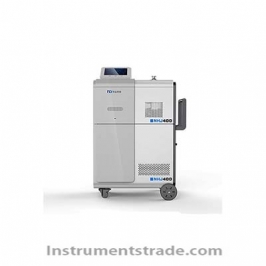
Position: Home > > Analytical instruments > Mass Spectrometry Equipment > Helium mass spectrometer leak detector > ZQJ-3300 Helium Mass Spectrometer Leak Detector

ZQJ-3300 Helium Mass Spectrometer Leak Detector

Product ID:HZhzp018

Price: Please inquire PDF Format
Supply Ability:50 SETS/MON
Port:SHENZHEN
  • Product Introduction
  • Other information
  • Model NumberZQJ-3300
    Brand NameBJZHONGKEKEYI
    Payment TermsTT,PAYPAL,Alibaba.com Pay
    ZQJ-3300 Helium Mass Spectrometer Leak Detector
     
    Product Introduction
    The ZQJ-3300 Helium Mass Spectrometer Leak Detector is designed to locate leaks and measure leak rates in sealed containers, vacuum systems, and industrial components. It uses helium or hydrogen as a tracer gas and a mass spectrometer to detect tracer gas entering through leaks.
    Helium is widely used as a tracer gas because of its low background concentration, small molecular size, low viscosity, and chemical inertness. These properties allow it to pass through small leak paths and diffuse readily without corroding equipment.
    With high-sensitivity detection, fast response, intelligent control, and a convenient trolley-style design, the ZQJ-3300 supports efficient leak testing in laboratory and industrial environments.


    Performance Features
    •   High Detection Sensitivity: Minimum detectable leak rate of 5×10⁻¹³ Pa·m³/s.
    •  Fast Response: Harmonic decoupling algorithm enables a response time of ≤1 second.
    •   Intelligent Control: Integrated controller displays and stores leak-rate curves.
    • Multiple Communication Interfaces: Supports RS232 and RS485 communication.
    •  Ergonomic Trolley Design: Mobile structure makes equipment handling and operation more convenient.
    •   Rapid Startup: Startup time of less than 3 minutes.


    Working Principle
    The ZQJ-3300 uses mass spectrometric analysis to detect tracer gas, typically helium. During testing, helium is introduced around the surface of the component or container under inspection. If a leak is present, tracer gas enters the system through the leak path and is detected by the mass spectrometer.
    The instrument analyzes the detected helium signal to identify the presence of leakage and determine the corresponding leak rate. Its leak-rate curve display and storage functions support real-time monitoring and test record management.


    Technical Parameters
    Parameter Specification
    Minimum Detectable Leak Rate 5×10⁻¹³ Pa·m³/s
    Measurement Range 5×10⁻¹³ to 1×10⁻¹ Pa·m³/s
    Maximum Test Pressure 2200 Pa
    Response Time ≤1 s
    Startup Time <3 min
    Communication Interfaces RS232 / RS485
    Power Supply 220 VAC ±10%, 50 Hz, 8 A
    Operating Temperature 5–45°C
    Operating Humidity <80% RH
    Dimensions (L × W × H) 757 × 482 × 944 mm
    Weight 82 kg


    Application Scenarios
    The ZQJ-3300 is suitable for high-sensitivity leak detection in applications such as:
    •   Vacuum equipment and vacuum chambers
    •   Sealed containers and industrial components
    •   Refrigeration and heat-exchange systems
    •   Semiconductor and electronic component manufacturing
    •   Aerospace and precision mechanical components
    •   Laboratory vacuum system inspection
    •   Industrial product sealing and quality control


    Comparison
    Feature ZQJ-3300 Helium Leak Detector Conventional Leak Testing Methods
    Detection Method Tracer gas mass spectrometry Depends on the selected method
    Tracer Gas Helium or hydrogen Often uses pressure change, liquid, or other indicators
    Minimum Detectable Leak Rate 5×10⁻¹³ Pa·m³/s Varies by method and equipment
    Response Time ≤1 s Depends on the test method
    Leak-Rate Monitoring Curve display and storage Depends on equipment configuration
    Communication RS232 / RS485 Varies by instrument
    Mobility Ergonomic trolley-style structure Depends on equipment design


    Frequently Asked Questions
    1. What is the ZQJ-3300 used for?
    It is used to locate leaks and measure leak rates in vacuum systems, sealed containers, and industrial components using tracer gas mass spectrometry.
    2. Why is helium commonly used as a tracer gas?
    Helium has a low background concentration, small molecular size, low viscosity, and chemical inertness, making it suitable for detecting small leaks.
    3. Can the ZQJ-3300 use hydrogen as a tracer gas?
    Yes. The instrument description specifies helium or hydrogen as tracer gases.
    4. What is its minimum detectable leak rate?
    The minimum detectable leak rate is 5×10⁻¹³ Pa·m³/s.
    5. How quickly does the instrument respond?
    Its specified response time is no more than 1 second.
    6. Does the instrument support data storage?
    Yes. Its intelligent controller supports leak-rate curve display and storage.
    7. What communication interfaces are available?
    The instrument supports RS232 and RS485 communication interfaces.
    8. How long does it take to start up?
    The specified startup time is less than 3 minutes.


  • Frequently Asked Questions
    1. What is the ZQJ-3300 used for?
    It is used to locate leaks and measure leak rates in vacuum systems, sealed containers, and industrial components using tracer gas mass spectrometry.
    2. Why is helium commonly used as a tracer gas?
    Helium has a low background concentration, small molecular size, low viscosity, and chemical inertness, making it suitable for detecting small leaks.
    3. Can the ZQJ-3300 use hydrogen as a tracer gas?
    Yes. The instrument description specifies helium or hydrogen as tracer gases.
    4. What is its minimum detectable leak rate?
    The minimum detectable leak rate is 5×10⁻¹³ Pa·m³/s.
    5. How quickly does the instrument respond?
    Its specified response time is no more than 1 second.
    6. Does the instrument support data storage?
    Yes. Its intelligent controller supports leak-rate curve display and storage.
    7. What communication interfaces are available?
    The instrument supports RS232 and RS485 communication interfaces.
    8. How long does it take to start up?
    The specified startup time is less than 3 minutes.


Products
Analytical instruments
Physical property test
Environmental monitoring and analysis
Lab general equipment
About us
About this website
Our service
Product purchase
Contact Us

Newsletter

Make Sure you dont miss interesting happenings by joining our newsletter program.

Contact Us
+86-18620722006
instruments@instrumentstrade.com