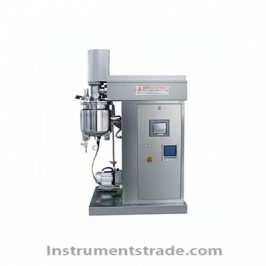
Position: Home > > Lab general equipment > Mixing / dispersing equipment > Homogeneous / emulsification > Scientz-150 Experimental High Pressure Homogenizer

Scientz-150 Experimental High Pressure Homogenizer

Product ID:SYHHFSjrh013

Price: Please inquire PDF Format
Supply Ability:50SETS/MONTH
Port:SHENZHEN
  • Product Introduction
  • Other information
  • Model NumberScientz-150
    Brand NameNBXINZHI
    Payment TermsTT,PAYPAL,Alibaba.com Pay
    Scientz-150 Experimental High Pressure Homogenizer
     
    Product Introduction
    The Scientz-150 Experimental High Pressure Homogenizer is designed for laboratory-scale sample processing in biotechnology, biopharmaceutical research, fermentation, and food applications. It uses adjustable high pressure and a specialized homogenizing valve to generate cavitation, impact, and shear forces, supporting microbial cell disruption, emulsification, homogenization, and particle size reduction.
    With a maximum working pressure of 1200 bar, an integrated cooling circulation system, and 316L stainless steel material-contact piping, the Scientz-150 is suitable for processing samples such as Escherichia coli and yeast. Optional secondary homogenization modules and application-specific homogenizing valves expand its versatility.


    Performance Features
    • High-pressure processing: Maximum working pressure of 1200 bar for intensive homogenization and cell disruption.
    •  Efficient particle reduction: Designed to produce uniformly refined particles below 100 nm under suitable processing conditions.
    •  Multiple processing effects: Combines cavitation, impact, and shear forces to improve sample dispersion and disruption.
    • Integrated cooling system: Built-in cooling circulation directly cools the homogenizing head to help manage processing heat.
    •  Corrosion-resistant wetted parts: Material-contact piping is made of 316L stainless steel.
    •   Flexible throughput options: Available in 12 L/h and 25 L/h configurations.
    •  Expandable configuration: Optional second-stage homogenization module and different homogenizing valves for specific applications.
    •  Compact laboratory design: Small footprint with imported key components and convenient operation.


    Working Principle
    The Scientz-150 uses a special plunger to force the sample into an adjustable-pressure homogenizing valve assembly. As the material passes through a narrow restriction, its pressure drops rapidly and its velocity increases. The resulting cavitation, impact, and shear forces disrupt cells, break down aggregates, and reduce particle size.
    These combined effects support microbial cell disruption, emulsification, and uniform dispersion. The integrated cooling circulation system helps remove heat generated during high-pressure processing, protecting temperature-sensitive samples when used with appropriate operating conditions.


    Technical Specifications
    Parameter Specification
    Model Scientz-150
    Equipment Type Experimental High Pressure Homogenizer
    Maximum Working Pressure 1200 bar / 120 MPa / 17,400 psi
    Maximum Design Pressure 1500 bar / 150 MPa / 21,750 psi
    Maximum Throughput 12 L/h or 25 L/h, depending on model
    Minimum Processing Volume 30 mL
    Cooling System Built-in cooling circulation system
    Material-Contact Piping 316L stainless steel
    Motor Power 1.5 kW
    Power Supply 380 V, 50 Hz
    Dimensions 800 × 460 × 450 mm (L × W × H)
    Weight 120 kg
    Optional Accessories Secondary homogenization module; application-specific homogenizing valves
    Stated Particle Size Below 100 nm under suitable processing conditions
    Stated Cell Disruption Rate Greater than 95%, depending on sample and operating conditions


    Application Scenarios
    •   Biotechnology laboratories: Disruption and processing of microbial samples.
    • Biopharmaceutical research: Homogenization of biological materials and preparation of experimental samples.
    •  Fermentation research: Processing of samples from fermentation systems, including E. coli and yeast.
    •  Pharmaceutical development: Emulsification, homogenization, and particle size reduction.
    • Food and beverage production: Processing of dairy products, juices, beverages, and other liquid formulations.
    •  Biological sample preparation: Improving dispersion and sample uniformity for downstream analysis.


    Scientz-150 vs. Conventional Laboratory Homogenization Equipment
    Comparison Item Scientz-150 High Pressure Homogenizer Conventional Low-Pressure or Rotor-Stator Homogenizer
    Processing Mechanism High-pressure valve with cavitation, impact, and shear Mechanical shear or lower-pressure mixing
    Maximum Working Pressure 1200 bar Depends on equipment
    Cell Disruption Suitable for microbial cell disruption Depends on sample and configuration
    Particle Size Reduction Designed for fine particle reduction, potentially below 100 nm Depends on equipment and formulation
    Cooling Integrated cooling circulation system Depends on model
    Material-Contact Piping 316L stainless steel Depends on model
    Throughput Options 12 L/h or 25 L/h Depends on model
    Typical Applications Biotechnology, pharmaceutical, fermentation, and food processing General mixing, dispersion, and homogenization


    Frequently Asked Questions
    1.  What is the Scientz-150 High Pressure Homogenizer used for?
    It is used for laboratory-scale cell disruption, emulsification, homogenization, and particle size reduction in biotechnology, pharmaceutical, food, and fermentation applications.
    2. What is the maximum working pressure?
    The maximum working pressure is 1200 bar (120 MPa), with a maximum design pressure of 1500 bar (150 MPa).
    3. Can it process E. coli and yeast samples?
    Yes. It is designed for microbial sample processing, including E. coli and yeast. Actual disruption performance depends on the organism, sample concentration, pressure, and number of passes.
    4. Can the Scientz-150 produce particles smaller than 100 nm?
    The supplied specifications state that particle sizes below 100 nm can be achieved. Actual results depend on the material, formulation, processing pressure, and number of passes.
    5. Does the equipment have a cooling system?
    Yes. It features built-in cooling circulation that directly cools the homogenizing head and helps control processing temperature.
    6. What throughput options are available?
    The listed maximum throughput options are 12 L/h and 25 L/h. Confirm the selected model and actual throughput at the required operating pressure.
    7. What materials contact the sample?
    The supplied information specifies 316L stainless steel for the material-contact piping. Confirm the materials of the valve, seals, and other wetted components for compatibility with your sample.
    8. Are optional accessories available?
    Yes. A secondary homogenization module and different homogenizing valves can be selected for different processing requirements.


  • Frequently Asked Questions
    1.  What is the Scientz-150 High Pressure Homogenizer used for?
    It is used for laboratory-scale cell disruption, emulsification, homogenization, and particle size reduction in biotechnology, pharmaceutical, food, and fermentation applications.
    2. What is the maximum working pressure?
    The maximum working pressure is 1200 bar (120 MPa), with a maximum design pressure of 1500 bar (150 MPa).
    3. Can it process E. coli and yeast samples?
    Yes. It is designed for microbial sample processing, including E. coli and yeast. Actual disruption performance depends on the organism, sample concentration, pressure, and number of passes.
    4. Can the Scientz-150 produce particles smaller than 100 nm?
    The supplied specifications state that particle sizes below 100 nm can be achieved. Actual results depend on the material, formulation, processing pressure, and number of passes.
    5. Does the equipment have a cooling system?
    Yes. It features built-in cooling circulation that directly cools the homogenizing head and helps control processing temperature.
    6. What throughput options are available?
    The listed maximum throughput options are 12 L/h and 25 L/h. Confirm the selected model and actual throughput at the required operating pressure.
    7. What materials contact the sample?
    The supplied information specifies 316L stainless steel for the material-contact piping. Confirm the materials of the valve, seals, and other wetted components for compatibility with your sample.
    8. Are optional accessories available?
    Yes. A secondary homogenization module and different homogenizing valves can be selected for different processing requirements.
Products
Analytical instruments
Physical property test
Environmental monitoring and analysis
Lab general equipment
About us
About this website
Our service
Product purchase
Contact Us

Newsletter

Make Sure you dont miss interesting happenings by joining our newsletter program.

Contact Us
+86-18620722006
instruments@instrumentstrade.com