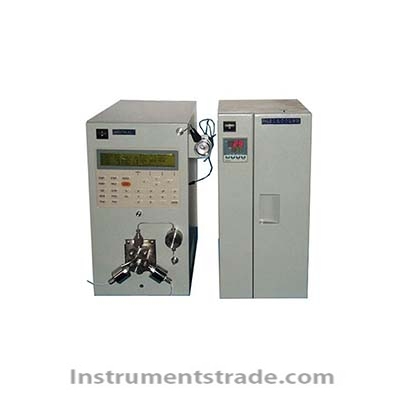
| Parameter | Specification |
| Flow range | 0.01 – 15 mL/min |
| Flow accuracy | <3 μL (0.01–0.1 mL/min), <1% (0.5–9.99 mL/min) |
| Mobile phase accuracy (B%) | ±0.5% ABS |
| Pressure range | 0.00 – 42 MPa (420 Kgf/cm²) |
| Pump type | Single-piston reciprocating pump |
| Motor drive | Imported motor, 20,000-step subdivision |
| Control system | Microprocessor-controlled proportional valve |
| Degassing | No-degassing single check valve design |
| Pulsation | High-performance imported damper |
| Program function | Multi-time gradient program, automatic memory |
| Display | LCD (pressure, flow rate, limit alarm) |
| Safety system | Overpressure alarm, auto shutdown |
| Structure | Vertical chassis, touch panel |
| Parameter | Specification |
| Optical system | Imported grating monochromator |
| Light source | Hamamatsu L6302 deuterium lamp |
| Wavelength range | 190 – 700 nm |
| Wavelength accuracy | ±1 nm |
| Wavelength repeatability | ±0.4 nm |
| Noise | 2.5 × 10⁻⁵ AU (254 nm, methanol) |
| Drift | 1 × 10⁻³ AU/hr |
| Attenuation range | 0.002 – 2 AU/mV (10 levels) |
| Detection cell volume | 4.5 μL |
| Cell pressure resistance | 120 Kgf/cm² |
| Minimum detection limit | 2 × 10⁻⁸ g/mL (naphthalene/methanol) |
| Lamp life | Up to 2500 hours |
| Feature | LC98IABB Analyzer | Conventional Analyzer |
| Analysis method | HPLC + pre-column derivatization | Basic chromatography |
| Amino acid coverage | 18 / 21 amino acids | Limited range |
| Pump system | Binary gradient, high pressure (42 MPa) | Lower pressure systems |
| Detection system | High-sensitivity UV (190–700nm) | Narrow wavelength range |
| Automation | Auto memory, program control | Manual operation |
| Stability | High precision, low drift | Moderate stability |
| Detection limit | 2 × 10⁻⁸ g/mL | Higher detection limit |

FAQ
Q1: How many amino acids can LC98IABB analyze?
It supports 18 or 21 amino acids, depending on configuration.
Q2: What industries use this analyzer?
It is widely used in food, feed, pharmaceutical, chemical, and biotechnology industries.
Q3: Can it work as a normal HPLC system?
Yes, it can also be used as a binary gradient HPLC system.
Q4: What detection method is used?
It uses a UV detector with wavelength range 190–700nm.
Q5: What is the pressure capacity?
The system supports up to 42 MPa high-pressure operation.

US$19,980.00 ~ US$35,980.00
US$18,000.00 ~ US$20,000.00
US$20,980.00 ~ US$39,980.00

Please inquire