Position: Home > > Physical property test > Thermal analysis instrument > Synchronous thermal analyzer > HCT-2 microcomputer differential thermal balance

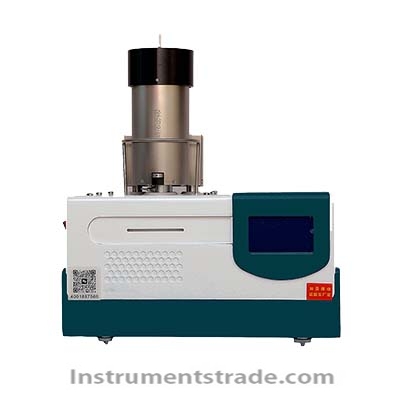
HCT-2 microcomputer differential thermal balance

Product ID:WLtb015

Price: Please inquire PDF Format
Supply Ability:50 SETS/MON
Port:SHENZHEN
  • Product Introduction
  • Other information
  • Model NumberHCT-2
    Brand NameBJHENGJIU
    Payment TermsTT,PAYPAL,Alibaba.com Pay
    HCT-2 microcomputer differential thermal balance 
    Introduction:
    The HCT-2 microcomputer differential thermal balance primarily measures physical and chemical changes related to heat, such as the melting point, heat of fusion, crystallization and heat of crystallization, heat of phase change reaction, thermal stability (oxidation induction period), glass transition temperature, adsorption and desorption, component content analysis, decomposition, combination, dehydration, additives, and other changes for research.
    Features:
    1. The heat flow DSC data acquisition method allows for the plotting of curves representing energy versus temperature;
    2. It is feasible to use standard samples to calibrate the accuracy of temperature, energy, and thermogravimetric measurements;
    3. The atmosphere control system employs a mass flow controller, allowing for automatic switching among three channels of pressure- and flow-stabilized gases during the experiment. It boasts high precision, excellent repeatability, and rapid response speed (an atmosphere control system resistant to various corrosive gases can be customized);
    4. Replacing the support rod allows for the adaptation of samples ranging from micro amounts to 10g, meeting various testing needs for different specimens;
    5. Fully automated measurement and plotting throughout the entire process, capable of handling routine data processing such as DSC, TG, DTG, DDTG, as well as data processing for DTA peak area, enthalpy calculation, kinetic parameter calculation, data comparison, calculation of activation energy using various algorithms, glass transition temperature, and specific heat measurement using comparative methods;
    6. During the system's sample collection process, real-time screenshots can be taken, and the measurement range can be automatically adjusted according to the magnitude of the output signal;
    7. Large-screen LCD display, real-time display of instrument status and data, two sets of temperature measurement thermocouples, independently displaying sample temperature and furnace temperature;
    8. We can develop software for free based on the calculation formula or method provided by the user;
    9. Self-developed constant temperature controller, constant temperature gas chromatography-mass spectrometry connector, and constant temperature belt, allowing for secondary detection of reaction gases.
    Technical Specifications:
    DSC data
    DSC measurement range ±1mW-±800mW
    DSC accuracy ±0.1μW
    temperature data
    temperature range Room temperature - 1250℃
    Temperature accuracy ±0.1℃
    heating rate 0.1℃/min-100℃/min
    Tianping Data (TG)
    measurement range 0.01mg to 200mg, with an adjustable support rod range of 0-10g
    resolution 0.1μg
    Thermal-gravity noise <0.1μg
    Vacuum degree (the instrument itself has vacuum sealing measures) After selecting and configuring the vacuum unit, it can reach 2.5×10-²Pa
    Atmosphere control system Use a mass flow controller
    Thermostat controller, thermostated gas chromatography and mass spectrometry connector; thermostated band (optional) Thermostatic range: room temperature to 200℃
    Differential thermal analysis (DTA)
    measurement range ±10μv-±2000μv
    DTA resolution 0.01μv
    crucible Standard configuration: ceramic crucible 0.06mL or 0.12mL
    Configuration options: aluminum crucible, graphite crucible, quartz crucible, platinum crucible


  • HCT-2 microcomputer differential thermal balance 
    Introduction:
    The HCT-2 microcomputer differential thermal balance primarily measures physical and chemical changes related to heat, such as the melting point, heat of fusion, crystallization and heat of crystallization, heat of phase change reaction, thermal stability (oxidation induction period), glass transition temperature, adsorption and desorption, component content analysis, decomposition, combination, dehydration, additives, and other changes for research.
Products
Analytical instruments
Physical property test
Environmental monitoring and analysis
Lab general equipment
About us
About this website
Our service
Product purchase
Contact Us

Newsletter

Make Sure you dont miss interesting happenings by joining our newsletter program.

Contact Us
+86-18620722006
instruments@instrumentstrade.com