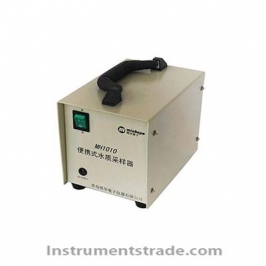
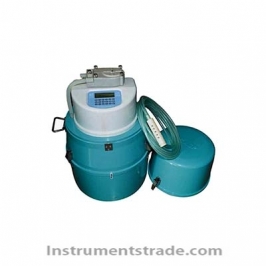
HC21 type automatic water quality sampler Introduction: The HC21 automatic water sampler is a specialized environmental monitoring instrument used for surface water and sewage sampling, water source monitoring, pollution source investigation, and total quantity control. It adopts the internationally common peristaltic pump water intake method and is controlled by a single-chip microcomputer. It can collect proportional mixed water samples and isochronous mixed water samples according to user needs, meeting the sampling requirements stipulated in the "Technical Specifications for Monitoring of Surface Water and Wastewater" (HJ/T91-2002) issued by the National Environmental Protection Administration. It operates using a 7.8AH high-capacity lithium battery, and in case of insufficient power during field work, a car battery can be used as a substitute. When equipped with a flow sensor, it simultaneously measures flow and stores the measured flow data and sampling conditions. The stored content is retained even when the power is lost, allowing for future review. It is one of the essential instruments for environmental monitoring and supervision stations at all levels to conduct water pollution monitoring work, as well as for environmental protection research departments to carry out research work. This product is widely used in various water environment scientific research, daily work of environmental monitoring stations, water conservancy and hydrology, health and epidemic prevention stations, disease control centers, universities, and environmental assessment departments, where portable water sampling is required. Features: 1. Automatically collect isochronous mixed water samples; 2. Made of stainless steel, it can be used in the wild all-weather conditions and is easy to carry; 3. Small and lightweight, easy to use; 4. Optional smart cloud management platform; 5. Independent research and development, modular design, high integration, low failure rate, and simple and convenient maintenance and repair. Technical parameters: Manual sampling volume: (5~10000mL) can be set arbitrarily, with increments of 1mL Automatic sampling volume: Time-proportional mixed sampling Sampling delay time: (1~9999 minutes) can be set arbitrarily, with increments of 1 minute Sampling interval: (1-9999 minutes) can be set arbitrarily, with increments of 1 minute Sampling volume: (5~10000mL) can be set arbitrarily, with increments of 1mL Number of mixed samples: (1~200) Flow-triggered sampling: Sampling is controlled by a dedicated flowmeter. An ultrasonic liquid level sensor is required, with a setting range of 1 to 9999 cubic meters of water, in increments of 1 cubic meter Pulse trigger sampling: 1 to 9999 pulses can be set arbitrarily, with increments of 1 pulse. The received pulses are passive pulses, with a closing time greater than 1 second Sampling flow rate: 3700 mL/min Inner diameter of pump tube: 10 mm Pump tube material: high-strength medical silicone tube Pump assembly material: The pump body is made of reinforced engineering plastic, featuring quick disassembly and assembly modules. The motor shaft and pump tube roller bracket are made of stainless steel Sampling volume error: ±5% Sampling repeatability: ±5mL. Vertical lift: 8m Horizontal suction lift: 50m Tightness of pipeline system: ≤-0.085MPa Operation interface: Large 2.8TFT color LCD screen, with all menus in Chinese, and human-machine dialogue mode. There are Chinese prompts whenever human intervention is required Pipeline rinsing: The pipeline is rinsed using the "blow-suction-blow" method to avoid cross-contamination of samples Software password lock: It can protect the programs set in the instrument from being modified Sampling program presets: Based on sampling requirements, 10 commonly used working programs can be preset and stored for direct access in the future Power-off protection: Upon power-off and subsequent restart, stored parameters and data will not be lost Sampling records: sampling time, sampling status, sampling bottle number. Capable of storing up to 5000 entries Flow record: time, instantaneous flow rate, cumulative flow rate. Capable of storing up to 6000 entries (requires optional ultrasonic level sensor) Water storage container: 10L polyethylene barrel System clock: Time control error: △1 ≤ 0.05% and △12 ≤ 3S Mean time between failures (MTBF): ≥1440 hours per occurrence Insulation resistance: >20MΩ Rated power: 28W Operating ambient temperature: -5℃ to +50℃ Working environment humidity: 5-85%RH Shell material: stainless steel, resistant to acid and alkali, corrosion, and anti-aging Protection level: IP65 Weight: 21kg Overall dimensions: 40cm×38.5cm×63.5cm (length × width × height)
HC21 type automatic water quality sampler Introduction: The HC21 automatic water sampler is a specialized environmental monitoring instrument used for surface water and sewage sampling, water source monitoring, pollution source investigation, and total quantity control. It adopts the internationally common peristaltic pump water intake method and is controlled by a single-chip microcomputer. It can collect proportional mixed water samples and isochronous mixed water samples according to user needs, meeting the sampling requirements stipulated in the "Technical Specifications for Monitoring of Surface Water and Wastewater" (HJ/T91-2002) issued by the National Environmental Protection Administration. It operates using a 7.8AH high-capacity lithium battery, and in case of insufficient power during field work, a car battery can be used as a substitute. When equipped with a flow sensor, it simultaneously measures flow and stores the measured flow data and sampling conditions. The stored content is retained even when the power is lost, allowing for future review. It is one of the essential instruments for environmental monitoring and supervision stations at all levels to conduct water pollution monitoring work, as well as for environmental protection research departments to carry out research work. This product is widely used in various water environment scientific research, daily work of environmental monitoring stations, water conservancy and hydrology, health and epidemic prevention stations, disease control centers, universities, and environmental assessment departments, where portable water sampling is required.