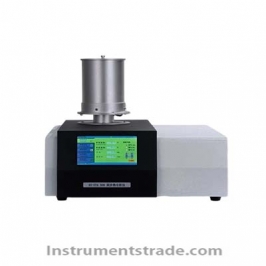
DSC-1250 High Temperature Differential Scanning Calorimeter Introduction: Differential Scanning Calorimetry (DSC), as a classic thermal analysis method for thermal effects under controllable program temperature, has been widely used in various fields of materials and chemistry, including research and development, process optimization, quality control, and failure analysis. By using DSC method, we can study the phase transition of inorganic materials, the melting and crystallization process of polymer materials, the polymorphic phenomenon of drugs, and the solid/liquid phase ratio of foods such as oils and fats. Instrument usage Measure physical and chemical changes related to heat, such as glass transition temperature, melting point, melting temperature, crystallization and crystallization heat, phase transition reaction heat, product thermal stability, curing/crosslinking, oxidation induction period, etc. characteristic: 1. The closed ceramic insulation furnace body structure greatly improves signal sensitivity and resolution, and can obtain a more stable baseline. 2. Equipped with an imported high-frequency core control processor, the processing speed is faster and the control is more efficient. 3. The sensor is designed with imported materials and equipped with K-type or E-type sensors that can be switched freely through software. The sensor type can be flexibly selected for different testing scenarios, especially suitable for phase transition and vitrification experiments on polymer materials. 4. Independent atmosphere control can be achieved through software intelligent settings, and the instrument can automatically switch the gas path system, resulting in higher experimental efficiency. 5. The lower and upper computers of the equipment system have multi-point temperature correction functions, which meet the needs of different experimental scenarios and improve the accuracy of temperature testing. 6. It has two experimental modes, FTC and STC, which can be set for more friendly and flexible temperature control, meeting the needs of different application scenarios and experiments. The temperature control during the experimental process is more accurate, the analysis of sensor signals is more efficient, and the experimental effect is accurately controlled. 7. The fully temperature control system adopts an optimized dynamic PID algorithm, which greatly avoids the shortcomings of traditional PID algorithms and improves the robustness of dual-mode temperature control. 8. The 12 step program temperature control setting makes the experimental methods more diversified, and the equipment has a cyclic scanning function, with a maximum of 9999 cyclic scanning times set and data automatically saved. The sampling frequency of sensor signals can be set between 1 and 10Hz, making the experimental method more flexible and the data more controllable. 10. The design concept of dual temperature sensors allows for simultaneous testing of both the internal temperature of the furnace and the sample temperature. 11. The equipment system can conduct experiments on materials related to heating, cooling, and isothermal processes. 12. The instrument adopts USB bidirectional communication, software intelligent design, baseline deduction function, automatic plotting of experimental process, and intelligent processing of various data, such as glass transition temperature, oxidation induction period, melting point and crystallization of substances, etc. Technical parameters: Temperature range: Room temperature~1250 ℃ Range: 0 to ± 2000mW Accuracy: ± 0.001mW Sensitivity: 0.001mW Heating rate: 0.1~80 ℃/min Temperature accuracy: 0.01 ℃ Temperature resolution: 0.01 ℃ Temperature fluctuation: ± 0.01 ℃ Temperature repeatability: ± 0.1 ℃ Sensor type: K-type, E-type can be switched freely (K-type standard, E-type optional) Timing frequency: 16.6Hz Experimental mode: FTC and STC modes can be set arbitrarily Program temperature control: flexible setting of 12 step temperature control throughout the entire stage Temperature control methods: heating, constant temperature, cooling Scanning type: heating, cooling, isothermal scanning Scanning times: The number of cyclic scans can be set up to 9999 times, and the data is automatically saved Atmosphere control: Two atmospheres can be freely set, and the instrument automatically switches Display mode: 24 bit color 7-inch LCD touch screen display Data interface: Standard USB interface Sampling rate: 1~10Hz, programmable Instrument calibration: Both the lower computer and the upper computer have multi-point temperature calibration functions Parameter standard: equipped with standard substances, users can correct the temperature by themselves
Introduction: Differential Scanning Calorimetry (DSC), as a classic thermal analysis method for thermal effects under controllable program temperature, has been widely used in various fields of materials and chemistry, including research and development, process optimization, quality control, and failure analysis. By using DSC method, we can study the phase transition of inorganic materials, the melting and crystallization process of polymer materials, the polymorphic phenomenon of drugs, and the solid/liquid phase ratio of foods such as oils and fats. Instrument usage Measure physical and chemical changes related to heat, such as glass transition temperature, melting point, melting temperature, crystallization and crystallization heat, phase transition reaction heat, product thermal stability, curing/crosslinking, oxidation induction period, etc.