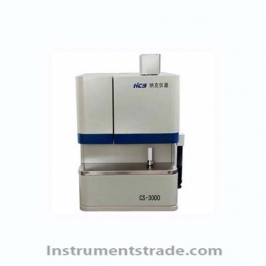
Position: Home > > Analytical instruments > Elemental Analyzer > Carbon sulfur analyzer > CS-8800C High-Frequency Infrared Carbon Sulfur Analyzer

CS-8800C High-Frequency Infrared Carbon Sulfur Analyzer

Product ID:FYtl016

Price: US$1.00 ~ US$0.00 PDF Format
Supply Ability:50SETS/MON
Port:SHENZHEN
  • Product Introduction
  • Other information
  • Model NumberCS-8800C
    Brand NameJINYIBO
    Payment TermsTT,PAYPAL,Alibaba.com Pay
    CS-8800C High-Frequency Infrared Carbon Sulfur Analyzer
     
    Product Introduction
    The CS-8800C High-Frequency Infrared Carbon Sulfur Analyzer is an advanced elemental analysis instrument integrating optical, mechanical, electrical, sensor, computer, and analytical technologies. It uses high-frequency furnace combustion combined with infrared absorption detection to accurately determine the mass fractions of carbon and sulfur in a wide range of materials.
    With a wide measurement range, strong interference resistance, high sensitivity, comprehensive functions, and simple operation, the CS-8800C carbon sulfur analyzer provides accurate and reliable results for routine laboratory and quality-control analysis.
    It is suitable for steel, iron, alloys, casting core sand, non-ferrous metals, cement, ores, coke, catalysts, magnetic materials, ceramics, inorganic materials, graphite, refractory materials, battery materials, plants, and other materials.


    Performance Features
    • High-frequency combustion technology: Provides rapid and complete combustion of samples.
    •  Infrared absorption detection: Enables sensitive and accurate carbon and sulfur measurement.
    •  Wide measurement range: Carbon from 0.00001% to 10.0000%; sulfur from 0.00001% to 6.0000%, expandable to 99.99999%.
    •  Dual carbon and dual sulfur cells: Automatically switches between detection cells according to concentration.
    •  High-speed 24-bit sampling: Dynamic data integration improves analytical sensitivity and accuracy.
    •  CO-to-CO₂ conversion: Improves the accuracy of carbon determination.
    •  7.5 kVA high-frequency ceramic power tube: Promotes complete sample combustion and stable operation.
    •  Automatic cleaning system: Snap-type automatic cleaning reduces dust-related interference and simplifies maintenance.
    •  Metal microporous dust filter: Efficiently reduces the influence of combustion dust on analytical results.
    •  Low-voltage heating ring: Improves sulfur conversion efficiency and sulfur analysis stability.
    •  Optical fiber connection: Separates the infrared detection system from the high-frequency furnace to reduce high-frequency interference.
    •  Enclosed purification system: Internal-pressure dust removal and purification design provides good sealing and convenient filter replacement.
    • Powerful software: Chinese Windows-based analytical software provides clear operation, data statistics, networking, and data transmission functions.


    Working Principle
    The CS-8800C carbon sulfur analyzer uses the high-frequency furnace combustion–infrared absorption method.
    A weighed sample is introduced into the high-frequency furnace and heated in an oxygen-rich environment. During combustion, carbon in the sample is converted primarily into carbon oxides, while sulfur is converted into sulfur oxides. The carbon-containing gas can be further converted to carbon dioxide to improve carbon measurement accuracy.
    The combustion gases are purified and passed through infrared detection cells. Carbon dioxide and sulfur dioxide absorb infrared radiation at their characteristic wavelengths. The infrared detector measures the corresponding absorption intensity, and the analytical software calculates the carbon and sulfur concentrations according to calibration data.
    For samples with extremely low or relatively high concentrations, the instrument can automatically select the appropriate carbon or sulfur detection cell, extending the effective analytical range while maintaining sensitivity and accuracy.


    Technical Parameters
    Parameter Specification
    Model CS-8800C
    Analysis Principle High-frequency furnace combustion + infrared absorption
    Elements Analyzed Carbon (C), Sulfur (S)
    Sensitivity / Minimum Reading 0.1 ppm
    Carbon Measurement Range 0.00001%–10.0000% (expandable to 99.99999%)
    Sulfur Measurement Range 0.00001%–6.0000% (expandable to 99.99999%)
    Detection Cells Carbon cell; optional low-carbon cell; sulfur cell; optional high-sulfur cell
    Analytical Error Complies with GB/T 20123-2006 / ISO 15350:2000
    Carbon Precision RSD ≤ 0.5%
    Sulfur Precision RSD ≤ 1.0%
    High-Frequency Furnace Power ≥2.7 kVA
    Oscillation Frequency 20 MHz
    High-Frequency Power Tube 7.5 kVA ceramic power tube
    Analysis Time 20–100 s adjustable; typically 35 s
    Electronic Balance Non-quantitative weighing; readability 0.0001 g
    Operating Temperature 10–30°C
    Relative Humidity <75% RH
    Power Supply AC 220 V ±5%, 50 Hz ±2%


    Application Scenarios
    The CS-8800C infrared carbon sulfur analyzer is widely used for material composition analysis and quality control in:
    •  Metallurgy: Steel, iron, alloys, and non-ferrous metals.
    •  Foundry industry: Casting materials and core sand.
    •  Cement and building materials: Cement, refractory materials, and inorganic materials.
    •  Mining and geology: Ores and mineral materials.
    •  Petroleum and chemical industries: Coke, catalysts, and related materials.
    •  Advanced materials: Graphite, magnetic materials, ceramics, and battery materials.
    • Research laboratories: Carbon and sulfur determination in various solid materials.
    •  Agricultural and biological research: Carbon and sulfur analysis of plant materials.


    CS-8800C vs. Conventional Carbon and Sulfur Analysis
    Feature CS-8800C High-Frequency Infrared Analyzer Conventional Chemical Analysis
    Detection Method High-frequency combustion + infrared absorption Chemical analysis
    Elements Carbon and sulfur Carbon and sulfur
    Analysis Speed Typically 35 s Generally longer
    Measurement Range Very wide Usually method-dependent
    Sensitivity 0.1 ppm minimum reading Depends on analytical method
    Automation Automatic detection and cell switching More manual operations
    Sample Combustion High-frequency furnace Chemical or conventional combustion
    Operator Workload Low Relatively high
    Interference Control Multiple isolation and purification measures Depends on method
    Data Processing Computerized analysis and statistics Often requires manual processing


    Frequently Asked Questions (FAQ)
    1.  What is the CS-8800C carbon sulfur analyzer used for?
    It is used to determine the carbon and sulfur content of steel, iron, alloys, minerals, cement, coke, graphite, ceramics, battery materials, and many other solid materials.
    2. What is the analysis principle of the CS-8800C?
    The analyzer uses high-frequency furnace combustion followed by infrared absorption detection.
    3. What is the minimum reading of the analyzer?
    The sensitivity or minimum reading is 0.1 ppm.
    4. What is the carbon measurement range?
    The standard carbon range is 0.00001%–10.0000%, expandable to 99.99999% under the corresponding configuration.
    5. What is the sulfur measurement range?
    The standard sulfur range is 0.00001%–6.0000%, expandable to 99.99999%.
    6. How long does one analysis take?
    The analysis time can be set from 20 to 100 seconds, with approximately 35 seconds as the conventional analysis time.
    7. Does the analyzer automatically switch detection cells?
    Yes. The dual carbon and dual sulfur cell configuration can automatically switch detection cells according to the concentration range.
    8. What standards does the CS-8800C comply with?
    The stated analytical error complies with GB/T 20123-2006 / ISO 15350:2000.


  • Frequently Asked Questions (FAQ)
    1.  What is the CS-8800C carbon sulfur analyzer used for?
    It is used to determine the carbon and sulfur content of steel, iron, alloys, minerals, cement, coke, graphite, ceramics, battery materials, and many other solid materials.
    2. What is the analysis principle of the CS-8800C?
    The analyzer uses high-frequency furnace combustion followed by infrared absorption detection.
    3. What is the minimum reading of the analyzer?
    The sensitivity or minimum reading is 0.1 ppm.
    4. What is the carbon measurement range?
    The standard carbon range is 0.00001%–10.0000%, expandable to 99.99999% under the corresponding configuration.
    5. What is the sulfur measurement range?
    The standard sulfur range is 0.00001%–6.0000%, expandable to 99.99999%.
    6. How long does one analysis take?
    The analysis time can be set from 20 to 100 seconds, with approximately 35 seconds as the conventional analysis time.
    7. Does the analyzer automatically switch detection cells?
    Yes. The dual carbon and dual sulfur cell configuration can automatically switch detection cells according to the concentration range.
    8. What standards does the CS-8800C comply with?
    The stated analytical error complies with GB/T 20123-2006 / ISO 15350:2000.
Products
Analytical instruments
Physical property test
Environmental monitoring and analysis
Lab general equipment
About us
About this website
Our service
Product purchase
Contact Us

Newsletter

Make Sure you dont miss interesting happenings by joining our newsletter program.

Contact Us
+86-18620722006
instruments@instrumentstrade.com