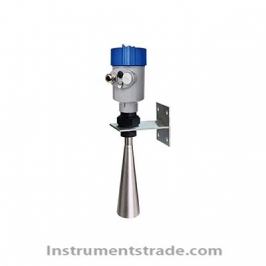
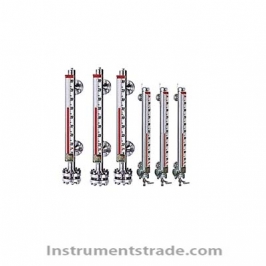
WSZ type ultrasonic water level gauge Introduction: The ultrasonic water level gauge is a digital level meter controlled by a microprocessor. During measurement, pulsed ultrasonic waves are emitted by a sensor (transducer), and the sound waves are reflected off the surface of the object and received by the same sensor, where they are converted into electrical signals. The distance from the sensor to the measured object is calculated based on the time between the emission and reception of the sound waves. Due to its non-contact measurement method, the measured medium is almost unlimited, making it widely applicable for measuring the height of various liquids and solid materials. Features: 1. Adopting SMD technology to enhance the reliability of the instrument. 2. It features automatic power adjustment, gain control, and temperature compensation. 3. Advanced detection technology and rich software functions adapt to various complex environments. 4. Adopting novel waveform calculation technology to enhance the measurement accuracy of instruments. 5. It has the function of suppressing interference echoes to ensure the authenticity of measurement data. 6. 16-bit D/A conversion enhances the accuracy and resolution of current output. 7. The sensor is made of tetrafluoroethylene material, which can be used in various corrosive environments. 8. Multiple output formats: programmable relay output, high-precision 4-20mA current output, and RS-485 digital communication output. Technical Specifications Measuring range: 0-3, 5, 8, 10, 15, 20m Accuracy: 0.25% Blind spot: 0.3-0.5m Operating temperature: -20℃ to +55℃ Power Supply: 24VDC or 220VAC Output: 4-20mA, RS-485 Control: Two-way relay (optional) Protection level: IP65 Display mode: 4-digit LED, 4-digit LCD, or 16-digit LCD x 2 (optional) Corrosion-resistant sensor housing: made of tetrafluoroethylene.
WSZ type ultrasonic water level gauge Introduction: The ultrasonic water level gauge is a digital level meter controlled by a microprocessor. During measurement, pulsed ultrasonic waves are emitted by a sensor (transducer), and the sound waves are reflected off the surface of the object and received by the same sensor, where they are converted into electrical signals. The distance from the sensor to the measured object is calculated based on the time between the emission and reception of the sound waves. Due to its non-contact measurement method, the measured medium is almost unlimited, making it widely applicable for measuring the height of various liquids and solid materials.