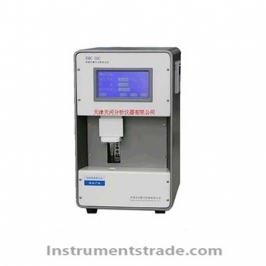
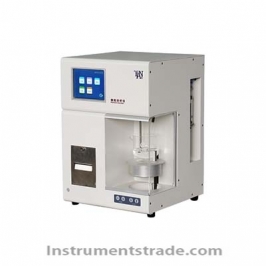
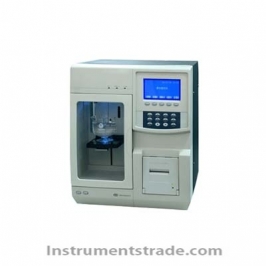
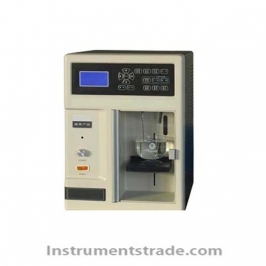
WCP-1 Particulate Contamination Testing Platform Introduction: GB 8368, "Disposable Infusion Sets - Gravity Infusion Type", specifies the testing method for particulate contamination of infusion sets. This method involves preparing an eluent and then testing it. However, the process of preparing the eluent is time-consuming, cumbersome, labor-intensive, and prone to failure due to human error. The "WCP-1 Particulate Contamination Testing Platform" developed by our company can complete the elution, collection, and detection of 10 infusion sets at once, achieving intelligent one-stop operation. The platform is easy to operate, and there is no need for personnel to be present during the testing process, greatly saving labor costs, improving testing efficiency, effectively regulating operational behavior, ensuring consistency in the testing process among various infusion sets, and avoiding the impact of human factors on the authenticity of test data. Features: 1. Specifically designed to simplify the tedious task of particulate contamination detection for infusion sets, it meets the detection requirements for particulate contamination of medical devices such as infusion sets as stipulated in GB 8368-2018 and related standards 2. High-performance processor, capable of customizing nearly ten thousand particle sizes with an accuracy of 0.1 µm, enabling high-precision data acquisition 3. Easy to operate, with one-click completion of standard tests, no personnel involvement required, saving manpower 4. Automatic water filling function, used for rinsing the inspected products 5. Automatically collect the rinsing solution and complete the test, featuring a blank automatic test function 6. Intelligent detection system, reducing waiting time during testing and improving detection efficiency 7. It features a customizable standard testing function, catering to the diverse testing needs of various users 8. Fully enclosed pipeline to prevent external contamination from affecting test results 9. High universality, suitable for infusion tubes with different types of connectors and puncture devices 10. The built-in database enables massive data storage and allows for retrieval, analysis, and statistics based on various conditions 11. Support multi-level account management and permission settings to enhance the traceability and security of the platform 12. With built-in audit tracking function, the integrity of electronic data is ensured, and the usage information and detection data of the equipment can be retrieved at any time 12. Support scanning input for easy information entry 14. Multiple options are available for printing the test report Technical Specifications: Number of tests: 1 to 10 pieces Channel setting: 64 (customizable) Particle size range: 10~100 μm Injection volume: 2~500 mL Injection volume accuracy: ±0.5% (500 mL) Counting accuracy: ≤ specified value ±10% Relative standard deviation: ≤2% (standard particle concentration ≥1000 particles) Limit detection concentration: 10,000 particles/mL Power Supply: AC 220 V ±10%; 50 Hz; ≤200 W Overall dimensions: 805x510x186 mm, 410x320x110 mm Overall weight: 87 kg Operating temperature: 10~40 ℃ Operating humidity: 5~80% RH Operating system: Windows Data output: Built-in micro thermal printer; USB storage interface, compatible with Lims laboratory platform
WCP-1 Particulate Contamination Testing Platform Introduction: GB 8368, "Disposable Infusion Sets - Gravity Infusion Type", specifies the testing method for particulate contamination of infusion sets. This method involves preparing an eluent and then testing it. However, the process of preparing the eluent is time-consuming, cumbersome, labor-intensive, and prone to failure due to human error. The "WCP-1 Particulate Contamination Testing Platform" developed by our company can complete the elution, collection, and detection of 10 infusion sets at once, achieving intelligent one-stop operation. The platform is easy to operate, and there is no need for personnel to be present during the testing process, greatly saving labor costs, improving testing efficiency, effectively regulating operational behavior, ensuring consistency in the testing process among various infusion sets, and avoiding the impact of human factors on the authenticity of test data.