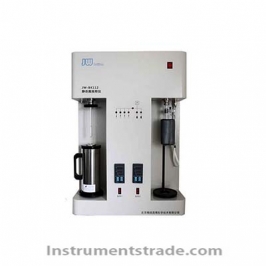
WBL-810 Fully Automatic Surface Area and Porosity Analyzer Introduction: The WBL series fully automatic specific surface area and porosity analyzer refers to ISO9277, ISO15901 international standards, and GB-119587 national standards. Based on the principle of static capacity measurement, it tests the adsorption and desorption process through mass balance equation, static gas balance, and pressure measurement. The testing process is carried out at liquid nitrogen temperature. After a known amount of gas is filled into the sample tube, it will cause a pressure drop. Therefore, the molar mass of the adsorbed gas at adsorption equilibrium can be calculated. By measuring the equilibrium adsorption capacity, the theoretical model is used to determine the single point and multi-point BET specific surface area and Langmuir specific surface area of the tested sample; Volume and area distribution of BJH mesopores and macropores, total pore volume; T-plot micropore volume and surface area, Dubinin Astakhov micropore distribution, Horvath Kawazoe micropore distribution; Parameters such as density function theory (DFT) and Monte Carlo (MC) aperture distribution model. Application scope: Research and product testing of various materials, including measuring zeolites, molecular sieves, silica, alumina, soil, clay, catalysts, organic metal compound skeleton structures, and other materials. Features: 1. Advanced modular air circuit design: The WBL series fully automatic specific surface area and porosity analyzer introduces advanced design concepts from around the world, adopting a unique modular all stainless steel vacuum air circuit design and advanced anti leakage and pollution-free measures to ensure the achievement of high vacuum and avoid the drawbacks of easy leakage due to too many connecting pipeline joints. 2. Constant temperature: The independently developed metal Dewar flask, due to its unique internal structure design, can store liquid nitrogen for more than ten days. During the experiment, there is almost no loss of liquid nitrogen, ensuring a constant temperature of the tested sample while avoiding the defect of fragile and immovable glass Dewar flasks. 3. High precision sensors: Multiple high-precision sensors and 22 bit AD conversion devices ensure the accuracy of specific surface area and aperture calculations. 4. Advanced theoretical models: Its advanced density function theory (DFT) and Monte Carlo (MC) pore size distribution model have established its dominant position in China's specific surface area and porosity analyzer industry, and are also at a high level internationally. 5. Operation automation: The adsorption and desorption processes are all controlled by computers, without the need for manual operation Analysis scope: 1. Single point and multi-point BET specific surface area, Langmuir specific surface area 2. BJH mesopore, macropore volume, area distribution, total pore volume 3. T-plot micropore volume and surface area, Dubinin Astakhov microporous distribution, Horvath Kawazoe micropore distribution 4. Density Function Theory (DFT) and Monte Carlo (MC) Aperture Distribution Model Output report: Directly print and EXCEL output adsorption desorption isotherms, BET specific surface area, Langmuir specific surface area, t-plot micropore volume, BJH pore volume, pore area, total pore volume, total pore area, Dbinin Astakhov, Horvath Kawazoe micropore distribution, NLDFT/GCMC pore distribution, and review report.
Introduction: The WBL series fully automatic specific surface area and porosity analyzer refers to ISO9277, ISO15901 international standards, and GB-119587 national standards. Based on the principle of static capacity measurement, it tests the adsorption and desorption process through mass balance equation, static gas balance, and pressure measurement. The testing process is carried out at liquid nitrogen temperature. After a known amount of gas is filled into the sample tube, it will cause a pressure drop. Therefore, the molar mass of the adsorbed gas at adsorption equilibrium can be calculated. By measuring the equilibrium adsorption capacity, the theoretical model is used to determine the single point and multi-point BET specific surface area and Langmuir specific surface area of the tested sample; Volume and area distribution of BJH mesopores and macropores, total pore volume; T-plot micropore volume and surface area, Dubinin Astakhov micropore distribution, Horvath Kawazoe micropore distribution; Parameters such as density function theory (DFT) and Monte Carlo (MC) aperture distribution model.