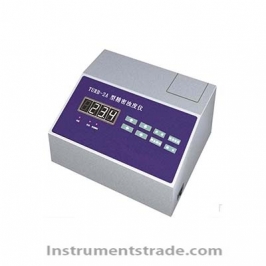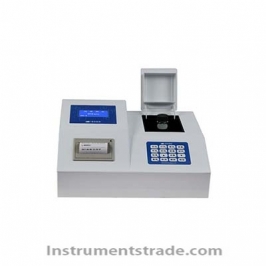
TSS-300 Suspended Solids Analyzer

Product ID:HSCzd030

Price: Please inquire PDF Format
Supply Ability:50 SETS/MON
Port:SHENZHEN
  • Product Introduction
  • Other information
  • Model NumberTSS-300
    Brand NameSZCHANGHONG
    Payment TermsTT,PAYPAL,Alibaba.com Pay
    TSS-300 Suspended Solids Analyzer
    Product Introduction
    The TSS-300 Suspended Solids Analyzer is a professional suspended solids meter designed for rapid measurement of suspended solids in water samples. It determines the concentration of suspended solids by measuring the absorbance of a sample at a specific wavelength and converting the optical signal into the corresponding concentration value.
    Featuring a cold light source and narrow-band interference optical system, the TSS-300 provides excellent optical stability and reliable measurement performance. It is widely used for surface water, sewage, and industrial wastewater analysis.
    The analyzer features a color touchscreen, bilingual Chinese/English interface, automatic calibration, large data storage capacity, curve management, printing, and USB connectivity, making routine TSS measurement simple and efficient.


    Key Features
    •  Stable Optical System: Cold light source and narrow-band interference optical system provide excellent optical stability.
    •  Wide Measurement Range: Measures suspended solids from 0 to 1000 mg/L.
    •  Color Touchscreen: User-friendly color touchscreen with Chinese and English display.
    •  Simple Operation: Fast and straightforward operation for routine TSS analysis.
    • One-Key Recovery: Quickly restores instrument settings to help prevent accidental loss of curves and measurement data.
    •  Built-in Calibration: Supports self-calibration to reduce drift errors caused by long-term operation.
    •  Large Data Storage: Stores up to 3,500 standard curves and 100,000 measurement values without data loss after power failure.
    •  Complete Curve Records: Allows users to review curve equations, standard values, corresponding absorbance values, calibration time, and operator ID.
    •  Printing Function: Measurement records can be printed individually or by page.
    • USB Interface: Can be connected to a computer for convenient data management.


    Working Principle
    The TSS-300 Suspended Solids Analyzer uses an optical measurement method. When light of a specific wavelength passes through the water sample, suspended particles in the sample absorb or scatter part of the incident light.
    The instrument measures the resulting optical signal and converts the absorbance value into a suspended solids concentration according to the calibrated standard curve.
    The built-in calibration function allows users to establish and store standard curves. During subsequent measurements, the analyzer compares the measured optical response with the selected calibration curve and displays the corresponding suspended solids concentration.


    Technical Specifications
    Parameter Specification
    Instrument Name Suspended Solids Analyzer
    Model TSS-300
    Measurement Parameter Suspended Solids (TSS)
    Measurement Range 0–1000 mg/L
    Repeatability ≤±3% F.S.
    Indication Error ≤±5% F.S.
    Minimum Resolution 0.1 mg/L
    Optical Stability ≤0.002 A/20 min
    Display Color touchscreen, Chinese/English display
    Dimensions 400 × 300 × 140 mm
    Net Weight 2.6 kg
    Power Consumption <100 W
    Operating Temperature 5–40°C
    Relative Humidity ≤85% RH
    Power Supply AC (220±22) V; (50±0.5) Hz
    Data Storage 3,500 standard curves; 100,000 measurement values
    Data Output USB
    Printing Single-record or page printing
    Operating Conditions: Avoid direct exposure to strong light. The installation environment should be free from significant vibration and strong electromagnetic interference.
     

    Applications
    The TSS-300 TSS analyzer is suitable for routine suspended solids measurement in:
    •  Surface water monitoring
    •  Sewage treatment
    •  Industrial wastewater analysis
    •  Wastewater treatment plants
    •  Environmental monitoring laboratories
    •  Water quality testing laboratories
    •  Industrial process water monitoring
    •  Environmental research and quality control


    TSS-300 vs. Conventional Suspended Solids Measurement
    Feature TSS-300 Suspended Solids Analyzer Conventional Measurement Methods
    Measurement Method Optical absorbance measurement Often requires manual or laboratory procedures
    Measurement Range 0–1000 mg/L Depends on method
    Resolution 0.1 mg/L Depends on method
    Optical Stability ≤0.002 A/20 min Depends on equipment
    Calibration Built-in self-calibration Often requires manual calibration
    Standard Curve Storage Up to 3,500 curves Usually limited or manual
    Measurement Data Storage Up to 100,000 values Often requires separate records
    Data Recovery One-key recovery May require manual backup
    Display Color touchscreen Varies
    Data Management USB connection Varies
    Printing Built-in printing function Depends on equipment
    Operation Simple and rapid May involve multiple manual steps
     

    Why Choose the TSS-300?
    The TSS-300 Suspended Solids Analyzer combines a stable optical system, automatic calibration, large-capacity data storage, curve management, and simple touchscreen operation in one compact instrument.
    For laboratories and environmental monitoring applications that require efficient suspended solids measurement, the TSS-300 provides a practical solution for surface water, sewage, and industrial wastewater analysis.


    FAQ
    1. What does the TSS-300 measure?
    The TSS-300 measures suspended solids concentration in water samples.
    2. What is the measurement range?
    The measurement range is 0–1000 mg/L.
    3. What is the minimum resolution?
    The minimum resolution is 0.1 mg/L.
    4. How does the TSS-300 measure suspended solids?
    It measures the sample's absorbance at a specific wavelength and converts the optical signal into suspended solids concentration using a calibration curve.
    5. Does the analyzer support calibration?
    Yes. The TSS-300 has a built-in calibration function that allows users to perform self-calibration and reduce long-term measurement drift.
    6. How much data can the TSS-300 store?
    It can store up to 3,500 standard curves and 100,000 measurement values, with data retained after power failure.
    7. Can users review calibration information?
    Yes. Users can review the curve equation, standard values, corresponding absorbance values, calibration time, and operator ID.
    8. Does the TSS-300 support data transfer?
    Yes. The analyzer is equipped with a USB interface for connection to a computer.
    9. What water samples can be tested?
    The TSS-300 is widely applicable to surface water, sewage, and industrial wastewater.
    10. What are the operating conditions?
    The recommended operating temperature is 5–40°C, with relative humidity ≤85%. Strong direct light, significant vibration, and strong electromagnetic interference should be avoided.


  • FAQ
    1. What does the TSS-300 measure?
    The TSS-300 measures suspended solids concentration in water samples.
    2. What is the measurement range?
    The measurement range is 0–1000 mg/L.
    3. What is the minimum resolution?
    The minimum resolution is 0.1 mg/L.
    4. How does the TSS-300 measure suspended solids?
    It measures the sample's absorbance at a specific wavelength and converts the optical signal into suspended solids concentration using a calibration curve.
    5. Does the analyzer support calibration?
    Yes. The TSS-300 has a built-in calibration function that allows users to perform self-calibration and reduce long-term measurement drift.
    6. How much data can the TSS-300 store?
    It can store up to 3,500 standard curves and 100,000 measurement values, with data retained after power failure.
    7. Can users review calibration information?
    Yes. Users can review the curve equation, standard values, corresponding absorbance values, calibration time, and operator ID.
    8. Does the TSS-300 support data transfer?
    Yes. The analyzer is equipped with a USB interface for connection to a computer.
    9. What water samples can be tested?
    The TSS-300 is widely applicable to surface water, sewage, and industrial wastewater.
    10. What are the operating conditions?
    The recommended operating temperature is 5–40°C, with relative humidity ≤85%. Strong direct light, significant vibration, and strong electromagnetic interference should be avoided.
Products
Analytical instruments
Physical property test
Environmental monitoring and analysis
Lab general equipment
About us
About this website
Our service
Product purchase
Contact Us

Newsletter

Make Sure you dont miss interesting happenings by joining our newsletter program.

Contact Us
+86-18620722006
instruments@instrumentstrade.com