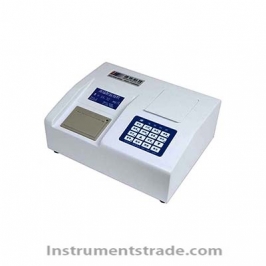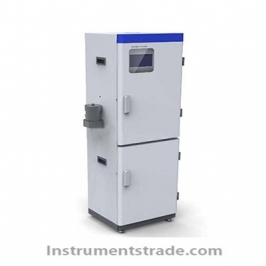
| Parameter | Specification |
| Model | SUPEC 5000A |
| Product Type | Fully Automatic Permanganate Index Analyzer |
| Configuration | Type A |
| Applicable Standard | GB 11892-1989 |
| Analytical Methods | Acidic and alkaline methods |
| Digestion Method | Boiling water bath |
| Measurement Range | 0–5 mg/L |
| Resolution | 0.001 mg/L |
| Minimum Detection Limit | ≤0.5 mg/L |
| Accuracy | ≤10% |
| Repeatability | ≤3% |
| Single-Sample Analysis Time | Approximately 5 minutes or longer |
| Standard Sample Capacity | 24 positions |
| Expandable Sample Capacity | Customizable |
| Sample Handling | Automatic robotic arm |
| Reagent Dosing | Automatic quantitative dosing |
| Titration System | High-precision metering pump for potassium permanganate |
| Operation | One-touch testing and cleaning |
| Data Management | Automatic data recording and template-based result reporting |
| Feature | SUPEC 5000A Automatic Analyzer | Conventional Manual Analysis |
| Sample Processing | Automated batch processing | Primarily manual handling |
| Sample Capacity | Standard 24-position tray | Depends on laboratory setup |
| Sample Transfer | Robotic arm | Manual transfer |
| Reagent Dosing | Automatic quantitative dosing | Manual or separately controlled dosing |
| Titration | Automated, precision-controlled system | Operator-performed titration |
| Analytical Methods | Acidic and alkaline methods | Depends on laboratory procedure |
| Operating Convenience | One-touch testing and cleaning | More repetitive manual operations |
| Data Recording | Automatic recording and template-based reporting | Often requires manual recording or separate software |
| Suitable Workload | Routine batch testing and higher-throughput laboratories | Small batches and laboratories with lower testing volumes |

Frequently Asked Questions
1. What does the SUPEC 5000A measure?
It measures the permanganate index of water samples, an indicator used to assess the content of readily oxidizable substances under specified analytical conditions.
2. Which standard does the SUPEC 5000A follow?
The analyzer is designed according to Chinese national standard GB 11892-1989, Water Quality—Determination of Permanganate Index.
3. Can the analyzer perform both acidic and alkaline methods?
Yes. A single SUPEC 5000A instrument supports both methods, allowing laboratories to select the appropriate procedure for their testing requirements.
4. What is the measurement range?
The specified measurement range is 0–5 mg/L, with a resolution of 0.001 mg/L.
5. What is the minimum detection limit?
The specified minimum detection limit is ≤0.5 mg/L. Confirm the validation procedure and applicable reporting limits for the intended application.
6. How many samples can be processed at one time?
The standard sample tray accommodates 24 positions. Higher-throughput configurations can be customized.
7. How long does it take to analyze one sample?
The specified single-sample analysis time is approximately 5 minutes or longer. Actual throughput depends on the selected analytical method, sample characteristics, and instrument operating sequence.
8. Can the instrument analyze colored or turbid water samples?
The instrument is designed for clear, colored, and turbid samples. Sample suitability and analytical performance should be verified for the specific water matrix and required method.
9. How does automation improve laboratory efficiency?
Automatic sample transfer, reagent dosing, digestion, titration, and data recording reduce repetitive manual tasks, help standardize analytical procedures, and support higher batch-testing efficiency.

Please inquire