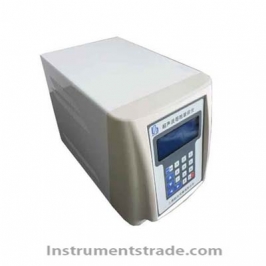
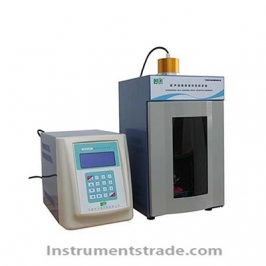
SCIENTZ-650J Integrated Ultrasonic Cell Disrupter Introduction: The SCIENTZ-650J integrated ultrasonic cell disruptor is a multifunctional and multi-purpose instrument that utilizes ultrasonic waves to generate cavitation effects in liquids. It can be used for the disruption of various cells, bacteria, viruses, and animal and plant tissues, as well as for emulsification, separation, homogenization, extraction, defoaming, cleaning, preparation and dispersion of nanomaterials, and acceleration of chemical reactions. Features: 1. Integrated design: The integrated design reduces the occupation of laboratory space 2. Electric lifting, with remote control option 3. Low noise: The chassis is surrounded by three-dimensional eco-friendly acoustic insulation panels to reduce noise pollution 4. Intelligentization: Ultrasound programmable 5. Flexible parameters: Ultrasonic power is continuously and finely adjustable in steps of 1% 6. Testing function: It features both pulsed and continuous operation, along with a testing function 7. Precision: Ultrasound time and gap time can be precise to 0.1 second 8. Alarm function: It features overload, overtemperature, and time alarm functions 9. High-quality material: TC4 military-grade titanium alloy extension rod 10. High cleanliness: The inner wall is smooth, making it easy to wipe clean Technical Specifications: Model: SCIENTZ-650J Frequency: 20-25KHz Display mode: 7-inch capacitive touch screen Ultrasonic power: 650W (1%-100%) Random amplitude lever: 6mm Optional jibs: 2mm, 3mm, 8mm, 10mm, 13mm Crushing capacity: 100ul-250ml Alarm temperature: 0~99.9℃ Overall dimensions: 312*334*510mm Transducer lifting method: electric, remotely controllable lifting Internal lighting: Yes Disinfection function: Yes
SCIENTZ-650J Integrated Ultrasonic Cell Disrupter Introduction: The SCIENTZ-650J integrated ultrasonic cell disruptor is a multifunctional and multi-purpose instrument that utilizes ultrasonic waves to generate cavitation effects in liquids. It can be used for the disruption of various cells, bacteria, viruses, and animal and plant tissues, as well as for emulsification, separation, homogenization, extraction, defoaming, cleaning, preparation and dispersion of nanomaterials, and acceleration of chemical reactions.