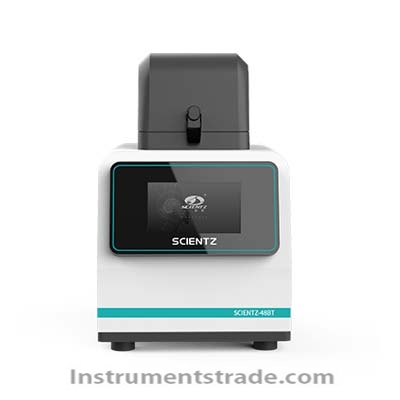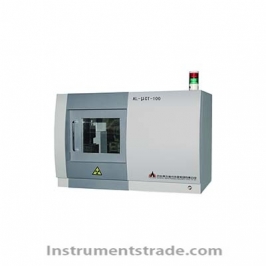
SCIENTZ-48BT Bone and Tooth Grinder

Product ID:SHDWqt036

Price: Please inquire PDF Format
Supply Ability:50 SETS/MON
Port:SHENZHEN
  • Product Introduction
  • Other information
  • Model NumberSCIENTZ-48BT
    Brand NameNBXINZHI
    Payment TermsTT,PAYPAL,Alibaba.com Pay
    SCIENTZ-48BT Bone and Tooth Grinder
    Product Introduction
    The SCIENTZ-48BT Bone and Tooth Grinder is a new-generation laboratory grinding system designed for fast, efficient, and safe sample processing. It supports the grinding and homogenization of animal tissues, bones, teeth, plants, microorganisms, food, polymers, and environmental samples for subsequent DNA, RNA, and protein extraction and purification.
    The system supports wet grinding, dry grinding, and pre-frozen grinding. Its high-throughput design can process up to 48 samples in a short time, helping reduce manual grinding labor and operator-dependent errors.


    Performance Features
    • Simple Operation: Place centrifuge tubes directly into the adapter; tubes can also be pre-frozen before grinding.
    • Low Contamination Risk: Fully enclosed grinding and independent sample movement help prevent cross-contamination.
    • Flexible Parameters: Built-in programmable controller enables convenient time and speed/frequency settings.
    • Low Noise: Silent design reduces disturbance to the laboratory environment.
    • High Safety: Safety door lock, lid-opening protection, and emergency braking improve operational safety.
    •  Stable Grinding: High-frequency vertical oscillation promotes thorough and consistent sample grinding.
    •  High Throughput: Processes up to 48 samples rapidly.
    •  Multiple Grinding Options: Supports wet, dry, and pre-frozen grinding with optional grinding jars and zirconia beads.


    Working Principle
    The SCIENTZ-48BT uses high-frequency vertical oscillation for sample grinding. According to sample properties, suitable grinding beads are selected and placed together with the sample in a centrifuge tube or grinding jar.
    During operation, the sample and grinding beads move rapidly and collide with each other. The resulting shearing and impact forces effectively disrupt tissues and other sample materials, facilitating the separation and extraction of DNA and RNA.


    Technical Specifications
    Parameter Specification
    Model SCIENTZ-48BT
    Power Supply 220 V / 50 Hz
    Rated Power 80 W
    Time Setting 1–9999 s
    Grinding Speed / Frequency 300–2100 rpm (10–70 Hz)
    Data Storage 50 sets
    Fixture Travel 34 mm, vertical
    Standard Sample Capacity 2 mL adapter, 48 holes; 5 mL adapter, 12 holes
    Optional Adapters 5 mL adapter, 24 holes; 2 mL adapter, 24 holes
    Optional Grinding Jars 5 / 10 / 15 / 25 / 50 / 100 mL
    Optional Accessory Freezing adapter
    Grinding Modes Wet, dry, pre-frozen grinding
    Standard Grinding Beads φ3 mm stainless steel balls ×1000; φ6 mm stainless steel balls ×1000
    Optional Grinding Beads Zirconia balls
    Display 7-inch TFT touchscreen
    Protection Lid-opening protection, emergency braking
    Cooling Temperature Range —
    Refrigeration Function No
    Dimensions L360 × W320 × H500 mm
    Weight ≤29 kg
     

    Suitable Samples
    Sample Category Typical Samples
    Animal Tissues Brain, heart, lung, stomach, liver, thymus, kidney, intestine, lymph nodes, muscle, bone, hair
    Microorganisms Yeast, E. coli
    Volatile Samples Coal, oil shale, wax products
    Plant Tissues Roots, stems, leaves, flowers, fruits, seeds
    Food & Pharmaceutical Samples Food products, tablets
    Plastics & Polymers PE, PS, textiles, resins
    Environmental Samples Soil, sediment, sludge, feces
     

    Application Scenarios
    The SCIENTZ-48BT is suitable for:
    •  Molecular Biology: Sample preparation for DNA and RNA extraction.
    •  Animal Tissue Research: Grinding bones, teeth, organs, muscles, and other biological tissues.
    •  Microbiology: Processing yeast, E. coli, and other microorganisms.
    •  Plant Research: Homogenizing roots, stems, leaves, seeds, fruits, and flowers.
    •  Food & Pharmaceutical Research: Grinding food materials and tablets.
    • Environmental Analysis: Processing soil, sediment, sludge, and fecal samples.
    •  Material Research: Grinding plastics, polymers, textiles, resins, coal, and oil shale.
    • High-Throughput Laboratories: Rapid parallel processing of up to 48 samples.


    Comparison: SCIENTZ-48BT vs. Manual Grinding
    Feature SCIENTZ-48BT Manual Grinding
    Sample Capacity Up to 48 samples Usually limited
    Grinding Method High-frequency vertical oscillation Manual mechanical force
    Grinding Consistency High consistency between repeated runs Operator-dependent
    Sample Contamination Enclosed, independent sample processing Higher handling exposure
    Parameter Control Programmable Manual
    Grinding Modes Wet, dry, pre-frozen Depends on manual method
    Labor Requirement Low High
    Reproducibility Improved through controlled parameters More dependent on operator
     

    FAQ
    1.  What is the SCIENTZ-48BT used for?
    It is a high-throughput laboratory grinder for bones, teeth, tissues, microorganisms, plants, food, polymers, and environmental samples, particularly for sample preparation before DNA, RNA, or protein extraction.
    2. How many samples can the SCIENTZ-48BT process at once?
    It can process up to 48 samples using the standard 2 mL, 48-hole adapter.
    3. Can the SCIENTZ-48BT grind bones and teeth?
    Yes. The instrument is designed for processing hard biological samples such as bones and teeth, with suitable grinding beads and containers selected according to the sample.
    4. Does it support pre-frozen samples?
    Yes. It supports pre-frozen grinding, and a freezing adapter is available as an option.
    5. What grinding modes are available?
    The SCIENTZ-48BT supports wet grinding, dry grinding, and pre-frozen grinding.
    6. What grinding beads are supplied as standard?
    The standard configuration includes 1,000 φ3 mm stainless steel balls and 1,000 φ6 mm stainless steel balls. Zirconia balls are available as an option.
    7. Can larger grinding containers be used?
    Yes. Optional 5, 10, 15, 25, 50, and 100 mL grinding jars are available.
    8. Does the instrument have a built-in refrigeration function?
    No. The technical specifications indicate that the SCIENTZ-48BT does not have a built-in refrigeration function, although pre-frozen grinding and an optional freezing adapter are supported.
    9. How is sample cross-contamination reduced?
    The grinding process is fully enclosed, and samples move independently, helping reduce the risk of cross-contamination between samples.


  • FAQ
    1.  What is the SCIENTZ-48BT used for?
    It is a high-throughput laboratory grinder for bones, teeth, tissues, microorganisms, plants, food, polymers, and environmental samples, particularly for sample preparation before DNA, RNA, or protein extraction.
    2. How many samples can the SCIENTZ-48BT process at once?
    It can process up to 48 samples using the standard 2 mL, 48-hole adapter.
    3. Can the SCIENTZ-48BT grind bones and teeth?
    Yes. The instrument is designed for processing hard biological samples such as bones and teeth, with suitable grinding beads and containers selected according to the sample.
    4. Does it support pre-frozen samples?
    Yes. It supports pre-frozen grinding, and a freezing adapter is available as an option.
    5. What grinding modes are available?
    The SCIENTZ-48BT supports wet grinding, dry grinding, and pre-frozen grinding.
    6. What grinding beads are supplied as standard?
    The standard configuration includes 1,000 φ3 mm stainless steel balls and 1,000 φ6 mm stainless steel balls. Zirconia balls are available as an option.
    7. Can larger grinding containers be used?
    Yes. Optional 5, 10, 15, 25, 50, and 100 mL grinding jars are available.
    8. Does the instrument have a built-in refrigeration function?
    No. The technical specifications indicate that the SCIENTZ-48BT does not have a built-in refrigeration function, although pre-frozen grinding and an optional freezing adapter are supported.
    9. How is sample cross-contamination reduced?
    The grinding process is fully enclosed, and samples move independently, helping reduce the risk of cross-contamination between samples.
Products
Analytical instruments
Physical property test
Environmental monitoring and analysis
Lab general equipment
About us
About this website
Our service
Product purchase
Contact Us

Newsletter

Make Sure you dont miss interesting happenings by joining our newsletter program.

Contact Us
+86-18620722006
instruments@instrumentstrade.com