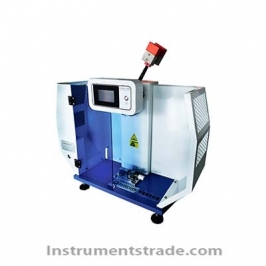
MZ-4068 Rubber and Plastic Low-Temperature Brittleness Tester Introduction: The MZ-4068 Rubber and Plastic Low-Temperature Brittleness Tester utilizes a novel semiconductor refrigeration (thermoelectric refrigeration) system, featuring a digital display for cooling temperature and high temperature control accuracy. This tester meets the requirements of GB/T 1682, GB/T15256, and GB/T5470, boasting a novel design, unique structure, stable performance, and high automation level. It is capable of determining the brittleness temperature and evaluating the low-temperature performance of various rubber materials or vulcanized rubbers and plastics with different formulations. Features: 1. Adopting semiconductor refrigeration (thermoelectric refrigeration) technology, with digital display of refrigeration temperature and high temperature control accuracy 2. High degree of automation, equipped with automatic temperature control, automatic timing, and automatic impact functions 3. Unique structure, novel design, stable performance, and easy operation 4. It can conduct single sample testing, suitable for use in laboratories and production sites Technical Specifications Test temperature: -60℃ to 0℃ Distance from the center of the impactor to the lower end of the gripper: Rubber: 8±0.3mm (multiple sample method) 11±0.5mm (single sample method) Plastic: 3.6±0.1mm After reaching constant temperature, the temperature fluctuation within 3 minutes at the test temperature should be less than ±0.5℃ Cold trap volume: 700ml Impact speed: 2±0.2m/s Power Supply: AC 380V±10% 50Hz 2kW Overall dimensions: 720mm×700mm×1250mm Host weight: 150kg
MZ-4068 Rubber and Plastic Low-Temperature Brittleness Tester Introduction: The MZ-4068 Rubber and Plastic Low-Temperature Brittleness Tester utilizes a novel semiconductor refrigeration (thermoelectric refrigeration) system, featuring a digital display for cooling temperature and high temperature control accuracy. This tester meets the requirements of GB/T 1682, GB/T15256, and GB/T5470, boasting a novel design, unique structure, stable performance, and high automation level. It is capable of determining the brittleness temperature and evaluating the low-temperature performance of various rubber materials or vulcanized rubbers and plastics with different formulations.