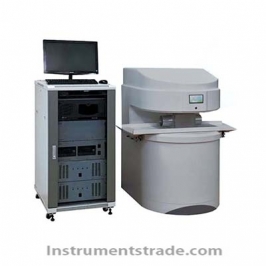
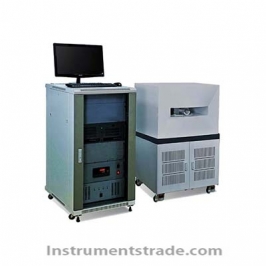
MacroMR12-150V-I Soil Triaxial Nuclear Magnetic Resonance Microstructure Imaging Analyzer Introduction: MacroMR12-150V-I is a core magnetic resonance analysis and imaging system launched by our company, integrating magnetic resonance relaxation analysis and imaging functions. The vertically enlarged bore magnet has a wide range of applications, and the push-pull sample feeding mechanism is specifically designed for experimental scenarios involving vertically placed samples. While achieving multi-field coupling such as temperature field, pressure field, chemical field, and seepage field, it organically combines with traditional mechanical measurement methods such as soil triaxial testing for joint measurement. Features: 1. Ultra-wide magnet chamber, easy sample loading without pressure: The vertically placed magnet is custom-developed for experimental scenarios considering gravity, and is suitable for core samples with diameters ranging from 25 to 100mm. 2. High-precision constant probe for you, advanced gradient system: stable and reliable data acquisition, achieving better imaging effects, as well as constant gradient layered detection during dynamic experiments. 3. Diverse accessory extensions: Multi-specification core holders and sample chambers enable the simulation of various real-world environments (temperature, pressure, fluid, gas, etc.), especially the coupled soil triaxial holder, which facilitates the joint measurement of low-field nuclear magnetic resonance and traditional mechanics. Technical Specifications: Product model: MacroMR12-150V-I Magnetic field strength: 0.30T±0.03T Magnet uniformity: ≤50ppm Magnet shape: vertically placed Sample injection method: longitudinal
MacroMR12-150V-I Soil Triaxial Nuclear Magnetic Resonance Microstructure Imaging Analyzer Introduction: MacroMR12-150V-I is a core magnetic resonance analysis and imaging system launched by our company, integrating magnetic resonance relaxation analysis and imaging functions. The vertically enlarged bore magnet has a wide range of applications, and the push-pull sample feeding mechanism is specifically designed for experimental scenarios involving vertically placed samples. While achieving multi-field coupling such as temperature field, pressure field, chemical field, and seepage field, it organically combines with traditional mechanical measurement methods such as soil triaxial testing for joint measurement.