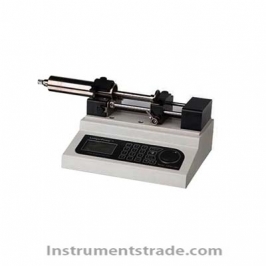
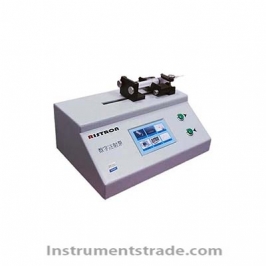
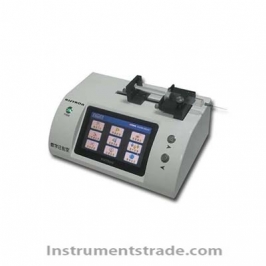
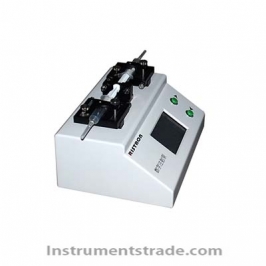
LP0310 high-pressure infusion pump Introduction: The series of high flow high-pressure infusion pumps and high-pressure metering pumps have a minimum flow increment of 0.1ml/min and are characterized by high flow accuracy, low pressure pulses, good repeatability, and stable quality. They support industrial networks such as Profinet, Ethercat, Ethernet/IP, Modbus/TCP, and can be easily connected and communicated with various automation equipment in industrial applications. They can be matched with Siemens, Beifu, Schneider, Omron, Panasonic, Mitsubishi, etc ABB、 PLCs from brands such as Huichuan, Delta, Rockwell, Omron, and Keyence achieve real-time data transmission and precise instruction execution. The high-pressure infusion pump and high-pressure metering pump series products are classified according to pump head materials, including stainless steel pumps, Hastelloy pumps, high-pressure PTFE pumps, and Peek pumps. They are widely used in chemical new material equipment, microreactors, chemical reaction devices, catalytic evaluation devices for chemical feeding, reactant addition, catalyst addition, supercritical fluid transportation, foaming extrusion processes, new energy research, catalytic refining kettle reactions, biological chromatography systems, DNA/RNA lipid nanoparticles and other equipment. Features: 1. High flow precision operation with microprocessor control, dual drive parallel pump head design, solvent compression compensation, multi-point flow curve correction technology, achieving high-precision fluid transportation in a wide dynamic range from low flow rate to high flow rate; The high-pressure infusion pump with 2-gradient design utilizes a brand new gradient design, which combines isocratic, linear, and step gradients to derive countless gradient curves with different shapes, greatly increasing your separation conditions; 3. The low pressure pulse adopts cam curve compensation and flow pulse electronic suppression technology to effectively control the fluid pressure pulse; 4. Excellent quality floating plunger design, reducing wear of high-pressure sealing rings, improving the service life of sealing rings, cam transmission design, Swiss imported one-way valve, quality assurance, low failure rate; 5 user-friendly interface with 10 built-in user programs, capable of implementing flow and gradient programming, providing a user-friendly human-machine interface; The computer anti control communication protocol for the 6 anti control program pump is open source, and you can also use other commonly used workstations to control the operation of the pump; Technical Specifications: Infusion method: Dual plunger parallel mode, floating plunger design Flow range: 0.1-3000.0ml/min Increment: 0.1ml/min Flow accuracy: ± 1.5% Traffic repeatability: ≤ 1.0% Pressure range: ≤ 10Mpa Pressure pulsation: ≤ 0.5Mpa Flow path material: 316L stainless steel, ruby PTFE、 ceramics Pipeline link: 1/4 "standard pipeline link Display parameters: 256 * 64 dot LCD display, self luminous display screen Communication function: RS232, USB (standard); RS485/422 (optional); Support three company protocols and Modbus protocol Power supply: 85-264VAC, 50Hz Size: 730 × 540 × 280 mm3
Introduction: The series of high flow high-pressure infusion pumps and high-pressure metering pumps have a minimum flow increment of 0.1ml/min and are characterized by high flow accuracy, low pressure pulses, good repeatability, and stable quality. They support industrial networks such as Profinet, Ethercat, Ethernet/IP, Modbus/TCP, and can be easily connected and communicated with various automation equipment in industrial applications. They can be matched with Siemens, Beifu, Schneider, Omron, Panasonic, Mitsubishi, etc ABB、 PLCs from brands such as Huichuan, Delta, Rockwell, Omron, and Keyence achieve real-time data transmission and precise instruction execution. The high-pressure infusion pump and high-pressure metering pump series products are classified according to pump head materials, including stainless steel pumps, Hastelloy pumps, high-pressure PTFE pumps, and Peek pumps. They are widely used in chemical new material equipment, microreactors, chemical reaction devices, catalytic evaluation devices for chemical feeding, reactant addition, catalyst addition, supercritical fluid transportation, foaming extrusion processes, new energy research, catalytic refining kettle reactions, biological chromatography systems, DNA/RNA lipid nanoparticles and other equipment.