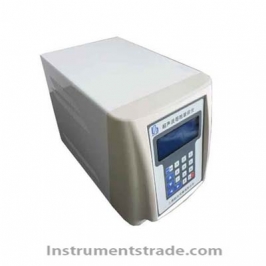
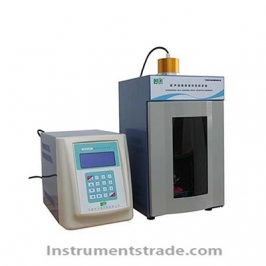
KBC-3080FJC-T non-contact ultrasonic processor Introduction: Compared to traditional probe contact ultrasonic cell crushers, non-contact samples can be crushed in a closed container without producing infectious flying mist. The ultrasonic probe does not come into contact with the sample, avoiding cross contamination. Application direction: Gradually becoming an indispensable standardized tool for ChIP (chromatin immunoprecipitation) and DNA splicing research platforms. characteristic: 1. Adopting color touch screen control, all functions are integrated and displayed. 2. The titanium alloy material of the amplitude rod is T1-6AL-4V. 3. Automatic frequency tracking, automatic sweep tracking within the frequency range of 20-80kHz. 4. Automatic energy compensation, which can automatically work at the optimal frequency and output points based on the fluidity of the sample. 5. The continuous pulse mode switch is independent and comes with two modes: pulse and timed continuous ultrasound. 6. The design of a three-dimensional exponential ultrasound probe far exceeds the output efficiency of traditional probe designs and reduces the loss of the amplitude rod. 7. The material of the piezoelectric variable frequency energy converter is CV33, PZT lead zirconate titanate piezoelectric ceramic. 8. Sample overload and fault automatic alarm protection device. Technical parameters: Model: KBC-3080FJC-T Overall dimensions: 280 * 196 * 207mm Ultrasonic frequency customization range: 20-80kHz Ultrasonic power customization range: 10-60W Adjustable working hours: 1min-100h Processing capacity: 100nL-3mL Adjustable pulse time: 1s-60min Customized range of probe diameter: Φ 3-12mm
Introduction: Compared to traditional probe contact ultrasonic cell crushers, non-contact samples can be crushed in a closed container without producing infectious flying mist. The ultrasonic probe does not come into contact with the sample, avoiding cross contamination. Application direction: Gradually becoming an indispensable standardized tool for ChIP (chromatin immunoprecipitation) and DNA splicing research platforms.