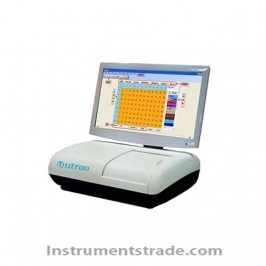
K6700FLA Multi-Function Microplate Reader Introduction: K6700FLA multi-function microplate reader application areas: Ca2+ flow experiment; FRET; cell proliferation; BRET; cytotoxicity; molecular beacon; cell adhesion; immunoassay; DNA quantification; enzyme activity detection; reporter gene detection; bacterial quantification; molecular hybridization experiment; phagocytosis; PCR product quantification; oligonucleotide assay; endpoint ELISA; kinetic detection; nucleic acid protein quantification; bacterial solution concentration analysis; MTT experiment; full-wavelength scanning of absorbance. Features: 1. Applicable to fluorescence, light absorption, and chemiluminescence tests, with multiple fitting curves for analysis; 2. Applicable to activity tests of protease, kinase, phospholipase, NADH, and GST; 3. Suitable for protein quantitative analysis, supporting methods such as UV, NanoOrange, Bradford, and Lowry; 4. Applicable to DNA/RNA analysis, supporting PicoGreen and RiboGreen methods; 5. Applicable to reporter gene analysis; 6. Supports methods such as dual luciferase assay, alkaline phosphatase assay, and luciferase assay; 7. Applicable to reactive oxygen species and ATP analysis, as well as cAMP analysis; 8. Applicable to cell proliferation and cytotoxicity tests, MTT, XTT; 9. Applicable to microbial growth, endotoxin, and bacterial concentration analysis; 10. Capable of performing spectral scanning; 11. Both the excitation and emission components feature a 12-position filter wheel, allowing for the selection of excitation and emission wavelengths; 12. The built-in grating monochromator has a wavelength range of 190-1000nm, with good adaptability; 13. Wavelength resolution of 1nm, with wavelength repeatability up to 0.2nm; 14. Equipped with a top-reading mode, suitable for most fluorescence analyses; 16. Equipped with kinetic analysis mode, kinetic ELISA, and enzymatic analysis; 17. Equipped with a temperature-controlled incubation system capable of reaching temperatures up to 45℃; 18. Equipped with microplate shaking and mixing function, eliminating the need for an external shaking table; 19. Use a xenon lamp light source, which features high intensity and stable light emission; 20. An automatic liquid feeder can be optionally installed for rapid detection; 21. Equipped with a sample detection probe and a reference probe, ensuring precise detection; 22. A microplate analysis workstation with powerful data analysis capabilities; 23. It features instrument parameter setting and self-checking functions, achieving a high degree of automation; 24. Equipped with a USB data interface, facilitating instrument control and data transmission; 25. The fully Chinese interface is suitable for domestic operators and teaching purposes; 26. The performance is not inferior to similar imported products, offering an extremely high cost-performance ratio; 27. Audit trail is available. Technical parameters: Fluorescence part: 1 Detector: Photomultiplier Tube (PMT) Excitation wavelength range: 320nm-1000nm; 3 Emission wavelength range: 360nm-800nm; 4 Wavelength resolution: 1nm; 5 Wavelength bandwidth: 30nm; 6 Wavelength accuracy: <0.2nm; 7 Fluorescence sensitivity: Top reading < 2 fmol 8 Detection order of magnitude: Top reading > 6 orders of magnitude 9 Reading method: top reading Chemiluminescence section: 1 Detector: Photomultiplier Tube (PMT) 2 Wavelength range: 270nm-670nm 3 Sensitivity: <40 amol ATP/well Dual-system light absorption part: Full-wavelength system 1 Detector: 2048CCD array detector 2 Wavelength range: 190nm-1000nm 3 Wavelength accuracy: ±1.0nm 4 Wavelength repeatability: <0.2nm 5 Linear range: 0-1.5 Abs 12-channel optical path detection system 1 Detector: Photocell 2 Wavelength range: visible light region 3 Wavelength accuracy: ±1.0nm 4 Wavelength repeatability: <0.2nm 5 Linear range: 0-4Abs Conventional characteristics 1 Light source: xenon lamp, tungsten lamp 2 Temperature control: (room temperature +2℃) to 45℃ 3 Oscillation mode: Linear 4 Oscillation amplitude: high, medium, low 5 Plate type: 6-384-hole plate