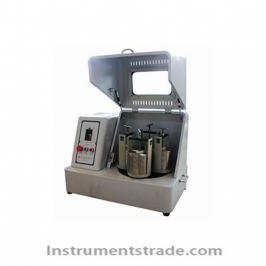
JXFSTPRP-MiniCL Immersion Liquid Nitrogen Freezing Grinder Introduction: At high temperatures, some substances (such as rubber, heavy metal elements, aromatic hydrocarbons, and food) are prone to denaturation, decomposition, and volatilization. However, low-temperature grinding of samples does not result in the loss of volatile substances and sensitive sample materials due to friction-induced heating. Volatiles can be retained in a sealed grinding jar. Other samples, such as bones, teeth, seeds, animal and plant tissues, and hair, have strong physical toughness and are difficult to grind. Low-temperature grinding can perfectly preserve the structural and compositional information and biological activity of the samples. Cell disruption can eliminate sample degradation and avoid damaging DNA and RNA. The choice of cryogenic grinding technology has become a key means of preserving the physicochemical integrity of samples, as low temperatures increase the brittleness of many tough and elastic samples, making them easier to grind, mix, and homogenize. Liquid nitrogen cryogenic grinders are widely used in fields such as commodity inspection and forensic identification. Features: 1. High accuracy and reproducibility of data; 2. During the grinding process, the sample is always kept in liquid nitrogen; 3. Throughout the entire grinding process, the samples are kept in an independently sealed and ultra-low temperature state, preserving their integrity, avoiding cross-contamination between samples, and ensuring control over dangerous and important samples; 4. The cleaning of the sample bottle is very convenient and it has high durability; 5. A touch-screen display is adopted, allowing for the setting and control of parameters such as pre-cooling time, grinding time, cycle period, and the operating frequency of the ram, as well as the entire working process of the instrument. It can pre-store 36 sets of data for easy access; 6. Adopting a portable design, it features a compact size and offers a variety of grinding combinations for users with different application needs to choose from; 7. The instrument possesses high durability, reliability, and safety. Technical Specifications: Product Name: Immersion Liquid Nitrogen Freezing Grinder Model: JXFSTPRP-MiniCL Grinding method: Electromagnetic vibration Operating frequency: adjustable from 1 to 20 times per second Working capacity: 0.1-200g Single grinding cycle: 2min Display operation: 8-inch LCD touch screen Power supply: 220V 50Hz Coil material: Imported anti-freezing copper Material of grinding jar: plastic/stainless steel Grinding time: 0-9999 seconds Number of grinding tasks: 1-4 Quick pre-cooling time: 4.5 minutes Immersible volume of liquid nitrogen: 10L Grindable temperature: zLow -196℃ Vibrating electronic material: chromium-free stainless steel Outline dimensions of the portable grinding chamber: 200*185*450mm (excluding the dimensions of the liquid nitrogen tank) Weight: 6kg
JXFSTPRP-MiniCL Immersion Liquid Nitrogen Freezing Grinder Introduction: At high temperatures, some substances (such as rubber, heavy metal elements, aromatic hydrocarbons, and food) are prone to denaturation, decomposition, and volatilization. However, low-temperature grinding of samples does not result in the loss of volatile substances and sensitive sample materials due to friction-induced heating. Volatiles can be retained in a sealed grinding jar. Other samples, such as bones, teeth, seeds, animal and plant tissues, and hair, have strong physical toughness and are difficult to grind. Low-temperature grinding can perfectly preserve the structural and compositional information and biological activity of the samples. Cell disruption can eliminate sample degradation and avoid damaging DNA and RNA. The choice of cryogenic grinding technology has become a key means of preserving the physicochemical integrity of samples, as low temperatures increase the brittleness of many tough and elastic samples, making them easier to grind, mix, and homogenize. Liquid nitrogen cryogenic grinders are widely used in fields such as commodity inspection and forensic identification.