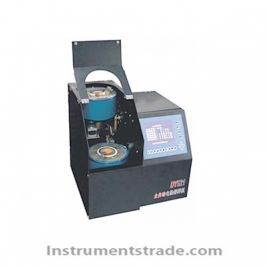
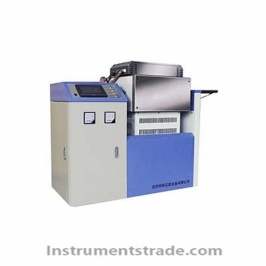
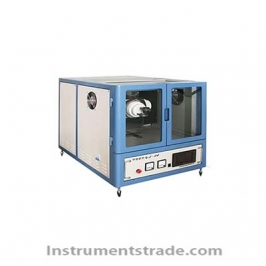
HNJC-T6D Fully Automatic Mould Pouring and Melting Machine Introduction: The HNJC-T6D automatic sample fusion machine is a glass fusion tablet sampling equipment for XRF analysis. Samples prepared using the glass fusion tablet method effectively reduce or even eliminate adverse factors such as matrix effects, particle effects, and mineral effects encountered during XRF analysis, greatly improving the accuracy of XRF analysis. The glass fusion tablet sampling method is widely used in industries such as steel, metallurgy, chemical, geology, and cement. This model of automatic sample fusion machine is a fully automatic sampling and preparation equipment designed specifically for this purpose. The overall design structure is reasonable, with a separate design for the heating furnace body and control components. User operation is simple, with minimal manual intervention. Users only need to load the sample, set the fusion program through the touch screen, and the fusion process is automatically completed with one click. During the fusion process, an adjustable automatic shaking system is designed to ensure the uniformity of the fusion tablet. The entire machine adopts a silicon carbide rod heating method, real-time temperature measurement with a thermocouple, PID constant temperature regulation, and PLC intelligent control. The machine excels in temperature control, stability, and operability, with a maximum heating temperature of up to 1400℃. It has good temperature adaptability to different sample materials, resulting in uniformly prepared samples of good quality that can meet the needs of customers in different industries for XRF analysis and sample preparation. Application fields: In industries such as steel, metallurgy, chemical engineering, geology, cement, and ceramic refractory materials, XRF analysis is conducted on samples including ore, rock, soil, refractory materials, and metallurgical raw materials, using glass fusion sample preparation techniques Features: 1. Utilizing advanced design concepts, the heating furnace body and control components are integrated into a desktop structure, ensuring a reasonable overall layout, compact size, and an elegant and aesthetic appearance. 2. The integrated safety door design and fixed crucible holder ensure safety without gas, flame, high-frequency radiation, or burn risk. The adjustable mold holder can accommodate molds of different sizes, including 30/32/34/36/37/40mm. 3. For an ideal melting environment, a lightweight crucible is all that is needed. The crucible should be corrosion-free, have a long service life, and save precious metals. It should feature a heating shield design, a halogen evacuation channel, and a 100% imported high-purity ceramic crucible support. 4. High-quality imported silicon carbide heating elements are selected, capable of reaching a maximum heating temperature of 1400℃, ensuring stable and long-lasting operation of the entire machine. 5. The interior lining of the heating furnace chamber is made of high-quality refractory insulation materials to ensure efficient utilization of electric heat in the heating chamber and temperature stability. 6. Real-time temperature measurement using thermocouples, PID constant temperature regulation, and PLC intelligent control ensure precise control during the sample preparation process, resulting in superior specimen quality. 7. The system features a full touchscreen display for operation, providing a user-friendly interface with minimal manual intervention. Simply load the sample, set the melting curve through the touchscreen, and the melting process is automatically completed with one click. 8. The design features a user-adjustable automatic rocking system, ensuring the uniformity and quality of the melted tablets, as well as an adjustable pouring and molding system. 9. Halogen exhaust channel: It promptly discharges corrosive gases generated at high temperatures, thereby extending the service life of equipment consumables. 10. Equipped with a one-button pre-oxidation melting system for ferroalloys, it is suitable for melting ferroalloys such as ferrosilicon, silicomanganese, ferromanganese, and ferrochromium, as well as ordinary samples such as iron ore and copper ore. 11. Thermocouple temperature control: guaranteed by the S platinum-rhodium thermocouple temperature control system. 12. The overall ceramic bracket does not contain any iron-based materials, ensuring no slagging or cracking even after prolonged use, and is easy to disassemble and assemble. 13. The entire bracket can be pickled with hydrochloric acid and can be reused multiple times, with a service life of up to 3 years. 14. Extensible remote control system for both mobile and PC terminals. 15. The instrument design incorporates multiple safeguards (such as overtemperature protection and swing motion limit protection) to ensure safe, stable, and reliable operation. 16. The pouring and casting process is completed inside the furnace, which results in minimal thermal radiation to the human body. A forced air cooling system is designed to accelerate the cooling of the molten pieces and improve efficiency. 17. The entire machine heats up quickly, maintains precise temperature control (±1°C), is energy-efficient, and operates stably. Its working temperature can reach up to 1300°C, and the bracket can withstand high temperatures of 1600°C. It exhibits good temperature adaptability to various sample materials, resulting in uniformly prepared sample slices that meet the requirements for XRF analysis. 18. It can melt six samples simultaneously in a single operation, offering high cost-effectiveness for the entire machine. Technical Specifications: Model: HNJC-T6D Temperature range: Room temperature - 1400℃ (the bracket can be used at temperatures up to 1600℃) Heating rate: Maximum 45°C/min (melting and heating stage) Heating method: Silicon carbide rod heating Sample melting position: 6 sample positions Molding method: Automatic mold pouring and molding Sample melting speed: 6 samples/10-18 minutes (depending on the complexity of the sample) Temperature control accuracy: ±1℃ (measured using an S-type platinum-rhodium thermocouple) Rated power and current: 8kW, 45A Power supply: Single-phase 220V/380V, 50/60Hz, protective grounding Crucible bracket material: The entire ceramic bracket is made without any iron-based materials Control system: touch screen, PLC control, PID thermostatic regulation The built-in function for one-click pre-oxidation and melting of ferroalloys is also applicable to the melting of ordinary samples Sample melting curve working mode and time for each stage: 1. Preheating → Oxidation → Melting → Mold pouring 2. The time for each stage is adjustable Equipment safety protection: disconnection protection, rod breakage protection, overheat protection, and motion limit position protection Crucible requirements: Platinum-gold crucible (Pt/Au:95/5) - 80 grams/set (Sets can be provided according to required quantity or purchased by the user) Instrument weight: 150kg (main unit + controller) Host dimensions (CL×W×H mm): 1130*680*645mm Recommended dimensions for placement platform: L*W*H 1400*800*800mm
HNJC-T6D Fully Automatic Mould Pouring and Melting Machine Introduction: The HNJC-T6D automatic sample fusion machine is a glass fusion tablet sampling equipment for XRF analysis. Samples prepared using the glass fusion tablet method effectively reduce or even eliminate adverse factors such as matrix effects, particle effects, and mineral effects encountered during XRF analysis, greatly improving the accuracy of XRF analysis. The glass fusion tablet sampling method is widely used in industries such as steel, metallurgy, chemical, geology, and cement. This model of automatic sample fusion machine is a fully automatic sampling and preparation equipment designed specifically for this purpose. The overall design structure is reasonable, with a separate design for the heating furnace body and control components. User operation is simple, with minimal manual intervention. Users only need to load the sample, set the fusion program through the touch screen, and the fusion process is automatically completed with one click. During the fusion process, an adjustable automatic shaking system is designed to ensure the uniformity of the fusion tablet. The entire machine adopts a silicon carbide rod heating method, real-time temperature measurement with a thermocouple, PID constant temperature regulation, and PLC intelligent control. The machine excels in temperature control, stability, and operability, with a maximum heating temperature of up to 1400℃. It has good temperature adaptability to different sample materials, resulting in uniformly prepared samples of good quality that can meet the needs of customers in different industries for XRF analysis and sample preparation. Application fields: In industries such as steel, metallurgy, chemical engineering, geology, cement, and ceramic refractory materials, XRF analysis is conducted on samples including ore, rock, soil, refractory materials, and metallurgical raw materials, using glass fusion sample preparation techniques