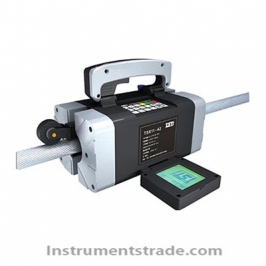
FET-99S Intelligent Digital Eddy Current Flaw Detector Introduction: The FET-99S intelligent digital eddy current flaw detector is suitable for online and offline flaw detection of metal tubes, rods, wires, steel pipes, steel rods, electromagnetic wires, copper wires, and aluminum wires, and can be used for automatic flaw detection of other mechanical components. It has a relatively independent testing channel that can drive a combined probe composed of differential coils. The detection channel simultaneously collects data for detecting metal tubes and rods The longitudinal cracks and transverse defects (such as joints) that occur in the production of wire, as well as axial defects such as hidden cracks and open cracks, have high sensitivity. Reliable detection of cracks and scratches caused by malfunctions during the production process. The signals obtained from the detection channel can be displayed in real-time on the screen using impedance plane diagrams and time-based scanning diagrams. With a testing frequency range of 100Hz-2MHz, it can adapt to the detection requirements of various metal materials, wires, etc. Due to its fully digital design, multiple standard detection programs or expert systems can be established within the instrument, making it convenient for users to use when changing product specifications. It is equipped with input and output control interfaces, making it easy to connect with various devices on site and work synchronously, forming a highly automated whole. characteristic: 1. Independent selectable frequency 2. Different style mode settings 3. Automatic phase and amplitude analysis function 4. Different styles of alarm area settings can be applied to various modes 5. Automatic screen clearing/tracking impedance display. 6. It has functions such as detecting signal playback, bidirectional access, etc 7. Fast analog/digital electronic automatic balancing and dynamic tracking filtering 8. The operation interface is simple, intelligent, and easy to operate 9. Compatible with various probes, such as external pass through type, rotary type, etc 10. Suitable for online and offline quality inspection of metal tubes, rods, metal parts, automotive parts, and production plants 11. Sound and light alarm output 12. Automatic balancing time 13. Selection of internal and external clocks 14. Can store a large amount of various detection programs and detection data 15. Extended function for eddy current signal playback 16. Automatically record display defects 17. Background selection between Cartesian coordinate system and polar coordinate system 18. Automatic calendar and time display Technical parameters: Frequency range: 64Hz-2MHz; : Gain: 0-60db, step size 0.5db Phase: 0-360 degrees, step length of 1 degree Automatic zero calibration system: can set the zero calibration interval time Gain ratio (X/Y): 0.1-10 Detection speed: 1m/min~360m/min Display mode: impedance, time base Display mode: solid line, blanking Hidden display coefficient: 1-100 Power supply: 220V (-20%~+20%), power consumption<10W
Introduction: The FET-99S intelligent digital eddy current flaw detector is suitable for online and offline flaw detection of metal tubes, rods, wires, steel pipes, steel rods, electromagnetic wires, copper wires, and aluminum wires, and can be used for automatic flaw detection of other mechanical components. It has a relatively independent testing channel that can drive a combined probe composed of differential coils. The detection channel simultaneously collects data for detecting metal tubes and rods The longitudinal cracks and transverse defects (such as joints) that occur in the production of wire, as well as axial defects such as hidden cracks and open cracks, have high sensitivity. Reliable detection of cracks and scratches caused by malfunctions during the production process. The signals obtained from the detection channel can be displayed in real-time on the screen using impedance plane diagrams and time-based scanning diagrams. With a testing frequency range of 100Hz-2MHz, it can adapt to the detection requirements of various metal materials, wires, etc. Due to its fully digital design, multiple standard detection programs or expert systems can be established within the instrument, making it convenient for users to use when changing product specifications. It is equipped with input and output control interfaces, making it easy to connect with various devices on site and work synchronously, forming a highly automated whole.