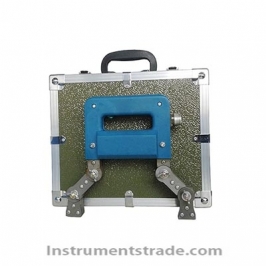
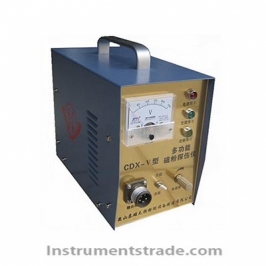
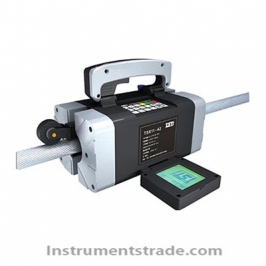
FET-5.01 eddy current flaw detector Introduction: Eddy current testing (ECT) is a technique used for non-contact inspection of metal components. Under the excitation of alternating current, the probe induces eddy currents in the inspected component. Any discontinuity or change in material properties that can alter eddy currents will be detected by the probe and considered a potential defect. Over the years, probe technology and data processing have made continuous progress, and now eddy current technology is recognized as a fast, simple, and accurate technique. This is precisely why eddy current technology is widely used in industrial sectors such as aviation, automotive, petrochemical, and power production to detect surface or near surface defects in materials such as aluminum, stainless steel, copper, titanium, brass, chromium nickel alloys, and even carbon steel. Technical parameters: Number of channels: 1-4 channels Probe recognition: automatic probe recognition and setting generator Number of generators: 1 (with built-in electronic reference) Voltage: 12 Vp-p, 10 Ω Operating frequency: 20 Hz to 6 MHz Bandwidth: 8 Hz to 5 kHz (in a single coil). Simultaneously, the gap forms an inverse proportional relationship and is set in multi-channel mode through the instrument. receiver Number of receivers: 1 to 4 Input signal: 1 Vp-p Gain: 28 dB to 68 dB data acquisition Digital frequency: 40 MHz Acquisition rate: 1 Hz to 15 kHz (in a single coil). The rate can be limited by the processing capacity of the instrument or by the delay setting of multiple excitation modes. A/D resolution: 16 bits data processing Phase rotation: 0 °~359 °, step pitch 0.1 ° Filtering: FIR low-pass, FIR high pass, FIR band-pass, FIR bandstop (with adjustable cutoff frequency), median filter (varying between 2 and 200 points), average filter (varying between 2 and 200 points) Channel processing mixing Data storage: The file capacity depends on the internal flash size: 180 MB (or 300 MB, optional) Data synchronization: according to the internal clock of 1 Hz to 15 kHz (single) External step speed: Yes, according to the encoder single axis or dual axis Alarm: alarm area shapes are fan-shaped, inverted fan-shaped, box shaped, inverted box shaped, and circular Output types: video, audio, and TTL signals Analog output: 1 (X or Y)
Introduction: Eddy current testing (ECT) is a technique used for non-contact inspection of metal components. Under the excitation of alternating current, the probe induces eddy currents in the inspected component. Any discontinuity or change in material properties that can alter eddy currents will be detected by the probe and considered a potential defect. Over the years, probe technology and data processing have made continuous progress, and now eddy current technology is recognized as a fast, simple, and accurate technique. This is precisely why eddy current technology is widely used in industrial sectors such as aviation, automotive, petrochemical, and power production to detect surface or near surface defects in materials such as aluminum, stainless steel, copper, titanium, brass, chromium nickel alloys, and even carbon steel.