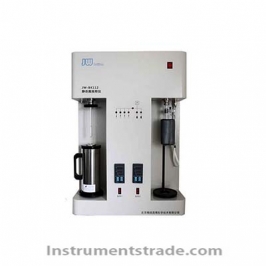
DX 400 specific surface area analyzer Introduction: DX400 is our company's latest high-efficiency specific surface area tester, which utilizes the principle of dynamic chromatography analysis to achieve rapid BET specific surface area measurement. Compared to traditional products, it surpasses them in both accuracy and speed Accuracy: It can accurately test standard samples with an ultra-small specific surface area of 0.1 m2/g, with precision reaching 0.01 m2/g. Fast: The testing speed is three times faster than that of traditional products, achieving an ultra-high testing efficiency of 28 standard samples per hour. It is highly suitable for testing battery cathode and anode materials such as lithium cobaltate, ternary materials, lithium iron phosphate, graphite, silicon carbide, as well as other samples with small specific surface areas. Features: 1. Precise calculation of desorption peak By incorporating the desorption process from the adsorption-desorption cycle into the peak area calculation, this method, verified through experiments, demonstrates higher accuracy and stability compared to the adsorption method. It is particularly suitable for the determination of small specific surface areas of ternary materials, graphite, and other battery anode and cathode materials. The experimental method can be selected from single-point BET or multi-point BET. 2. Can be connected and remotely accessed The instrument communication interface is a LAN port, which allows a computer to serve as the host computer for centralized control, enabling remote access and control of the host computer. 3. Independent degassing system Equipped with a fully independent degassing system, it offers two options: purging and vacuuming, providing a more intelligent, flexible, and convenient pre-treatment of samples. It does not occupy the analysis station for sample pre-treatment, thus improving testing efficiency. 4. Intuitive display of operating status The front panel of the instrument is equipped with a status display system that shows the working principle diagram of the instrument. Each valve position is equipped with an LED light to indicate the on/off status of the solenoid valve, allowing for intuitive judgment of the instrument's operation during the experiment. 5. Proprietary technology for sample chuck It retains the simplicity and ease of operation of quick-connect fittings when installing sample tubes, without the risk of air leakage caused by damage to the sealing components due to multiple uses. This clamp can be repeatedly disassembled and assembled while ensuring sealing, and can withstand higher pressure without leaking compared to quick-connect fittings. 6. Safety protection mechanism To ensure the operational safety of the instrument, (1) a wake sensor is added to the TCD detector to prevent dry burning, ensure the stability of the TCD signal, and extend the service life of the TCD detector. (2) A low-level monitoring program is developed to monitor the operating status of the instrument. When the instrument encounters abnormalities or other dangers, it automatically controls the instrument to eliminate the dangerous abnormalities and protect the safety of the instrument and operators. 7. Multiple Dewar flask options available High-performance vacuum glass-lined Dewar flasks, custom-produced using proprietary technology, combine the insulation effect of glass liners with the safety performance of metal liners, making them less prone to breakage. These cost-effective vacuum glass-lined Dewar flasks boast excellent insulation performance and are capable of testing more than 10 samples consecutively. Metal-lined Dewar flasks ensure accurate results and offer an extremely high safety factor; Technical Specifications: Test principle: Flow chromatography low-temperature nitrogen adsorption Test gas: High-purity 3:7 nitrogen-helium mixture (99.9999%) Detector: Customized thermal conductivity cell accurate to 0.1mV, capable of testing samples with an area of 0.1 m2/g to an accuracy of 0.01 m2/g. Specific surface area range: >0.1 m2/g, standard sample test repeatability <1%, parallelism <1%, long-term stability <1% Analysis stations: 4 Host specifications: Length 700mm × Width 410mm × Height 785mm, weight approximately 30 Kg Environmental temperature requirement: 15-35℃ Environmental humidity requirement: 20%-80%, ensuring no condensation occurs Power requirements: 100-240VAC, 50/60HZ, maximum power 200W Recommended application areas: cathode and anode materials for batteries such as lithium iron phosphate, ternary, graphite, lithium cobaltate, lithium manganate, as well as other materials with small specific surface area.
DX 400 specific surface area analyzer Introduction: DX400 is our company's latest high-efficiency specific surface area tester, which utilizes the principle of dynamic chromatography analysis to achieve rapid BET specific surface area measurement. Compared to traditional products, it surpasses them in both accuracy and speed Accuracy: It can accurately test standard samples with an ultra-small specific surface area of 0.1 m2/g, with precision reaching 0.01 m2/g. Fast: The testing speed is three times faster than that of traditional products, achieving an ultra-high testing efficiency of 28 standard samples per hour. It is highly suitable for testing battery cathode and anode materials such as lithium cobaltate, ternary materials, lithium iron phosphate, graphite, silicon carbide, as well as other samples with small specific surface areas.