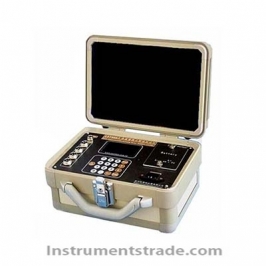
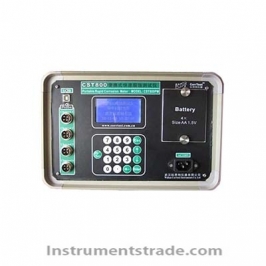
CST840 Soil Corrosion Tester Introduction: The CST840 soil corrosion tester integrates the advantages of linear polarization and alternating current impedance (EIS) measurement principles, with strong anti-interference ability, stable and reliable data, easy operation, rapid measurement, and intuitive display of results. All instruments adopt AC impedance measurement mode, which can accurately measure the dielectric resistance Rs and polarization resistance Rp between the working electrode and the reference electrode, thereby obtaining accurate corrosion rate. This is particularly suitable for corrosive environments with high dielectric resistance, such as oily wastewater, soil or concrete systems. The testing instrument is equipped with a corrosion monitoring probe, which can obtain data such as polarization resistance, dielectric resistance, corrosion current, open circuit potential, corrosion rate, etc. The pH probe can be used to measure pH data, the resistivity probe can be used to measure resistivity data, and the ORP electrode and copper sulfate reference electrode can be used to measure redox potential data. characteristic: 1. The instrument adopts timed automatic measurement, with a built-in real-time calendar clock, which can automatically wake up the measurement at a fixed time and can be used for continuous monitoring on site. The power supply adopts automatic switching between AC and DC, with a built-in rechargeable battery for portable use in the absence of power on site. It can continuously measure for 60 hours when fully charged. The CST840 soil corrosion tester can be used for manual measurement or installed on-site for timed automatic measurement. Built in 16M bytes flash memory, capable of storing test calendar time and data simultaneously, with a maximum storage capacity of 10000 sets of data. Flash memory ensures that data is saved even after the instrument is powered off, providing convenience for on-site applications. The test data can also be transmitted to a PC via USB using CST840 corrosion testing software, making it convenient for users to process and archive data on the PC. The polarization resistance, solution resistance, and corrosion rate time curve can be displayed on the screen, and the software can also predict future development status based on changes in corrosion rate. 3. In addition to being controlled by screen touch, the instrument can also be fully controlled by Windows based upper computer software through a serial communication port, enabling remote control and data reading of the instrument. Technical parameters: Product model: CST840 Corrosion rate measurement range: 0.1μm/a~10mm/a Absolute measurement accuracy: ± 1% Input impedance: 1 × 10¹¹ Ω Corrosion potential measurement range: -2.5V~+2.5V Potential resolution: 0.1mV Measurement range of dielectric resistance: 10 Ω~500K Ω Polarization resistance measurement range: 5 Ω~ 10M Ω Corrosion current density measurement range: 2.6 × 10⁻⁶mA/cm2~5.2mA/cm2 Measurement range of oxidation-reduction potential: -2V~+2V Soil pH measurement range: 1~14 Soil resistivity measurement range: 10 Ω· m~1M Ω· m Sine wave amplitude: 1mV~100mV Sine wave frequency: 0.001Hz~10kHz Timed measurement: measurement interval of 1-255 hours Calendar clock error:<1 minute/month Storage: 10, 000 groups Communication method: USB Power supply: adapter DC8.4V/7.2V 8000mAh rechargeable lithium battery Size: 323mm × 275mm × 135mm Weight: 3.5 kg Working temperature: -30 ° C~60 ° C Working humidity: ≤80% Shell material: plastic Protection level: IP65
Introduction: The CST840 soil corrosion tester integrates the advantages of linear polarization and alternating current impedance (EIS) measurement principles, with strong anti-interference ability, stable and reliable data, easy operation, rapid measurement, and intuitive display of results. All instruments adopt AC impedance measurement mode, which can accurately measure the dielectric resistance Rs and polarization resistance Rp between the working electrode and the reference electrode, thereby obtaining accurate corrosion rate. This is particularly suitable for corrosive environments with high dielectric resistance, such as oily wastewater, soil or concrete systems. The testing instrument is equipped with a corrosion monitoring probe, which can obtain data such as polarization resistance, dielectric resistance, corrosion current, open circuit potential, corrosion rate, etc. The pH probe can be used to measure pH data, the resistivity probe can be used to measure resistivity data, and the ORP electrode and copper sulfate reference electrode can be used to measure redox potential data.