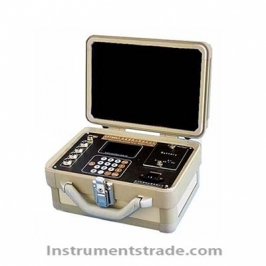
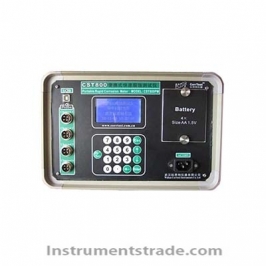
CST730 anode ladder corrosion monitoring instrument Introduction: The CST730 anode ladder corrosion monitoring instrument uses electrochemical impedance and 6-array anode ladder sensors to measure the corrosion damage status of steel bars in concrete. It can measure the self corrosion potential, corrosion rate, and concrete resistivity of carbon steel or stainless steel anodes with different burial depths. By measuring the self corrosion potential of six equidistant steel bars (anodes) on the anode ladder relative to the reference electrode, as well as the electric current between the anode ladder and the titanium cathode, the electrical resistivity between two adjacent anodes, and the temperature and humidity of the concrete, the dynamic process of steel reinforcement corrosion development in concrete is studied. The CST730 anode ladder corrosion monitoring instrument sensor includes 6 trapezoidal carbon steel rods (A1, A2,... A6), 1 MnO2 long-term reference electrode, 1 titanium alloy cathode, and 1 steel bar electrode. The tester can measure the self corrosion potential of 6 carbon steel rods and steel mesh relative to the MnO2 reference electrode, the galvanic current between A1~A6 and the titanium alloy electrode, the impedance between adjacent steel rods A1~A6, the impedance between A1~A6 and the steel electrode, as well as the temperature inside the concrete. During the corrosion process of concrete, as CO2, chloride ions, and moisture invade inward, the blunting front of the concrete continuously extends inward. As the invasion depth increases, the electrode potential, galvanic current, and impedance values of the anode array at different distances from the surface on the anode ladder will undergo significant changes. By analyzing the variation curves of electrochemical parameters of anode arrays at different depths over time and position, the variation law of concrete carbonation depth over time can be calculated, and the corrosion time of steel bars in concrete can be predicted, providing guidance for preventive maintenance of concrete scaling. Technical parameters: Product model: CST730 Number of measurement channels: 6 potential, 6 current, and 6 impedance channels Speed measurement range: 0.1μm/a~10mm/a Measurement accuracy: ± 1% Input impedance: 1 × 10¹¹ Ω Corrosion potential measurement range: -2.5V~+2.5V Potential resolution: 1mV Current measurement range: -10 mA~+10 mA Impedance measurement range: 100 Ω~10M Ω Sine wave amplitude: 10 mV~100mV Sine wave frequency: 10kHz~0.001Hz Regular measurement: measurement interval of 1-255 hours Calendar clock error:<1 minute/month Storage: 2 Mbytes, Can store 10000 sets of data Communication method: RS485, Standard Modbus protocol Power supply mode: DC12V Size: 180mm × 130mm × 60mm Weight: 2.0 kg Working temperature: -30 ° C~60 ° C Working humidity: ≤ 80% Shell material: plastic Protection level: IP67
Introduction: The CST730 anode ladder corrosion monitoring instrument uses electrochemical impedance and 6-array anode ladder sensors to measure the corrosion damage status of steel bars in concrete. It can measure the self corrosion potential, corrosion rate, and concrete resistivity of carbon steel or stainless steel anodes with different burial depths. By measuring the self corrosion potential of six equidistant steel bars (anodes) on the anode ladder relative to the reference electrode, as well as the electric current between the anode ladder and the titanium cathode, the electrical resistivity between two adjacent anodes, and the temperature and humidity of the concrete, the dynamic process of steel reinforcement corrosion development in concrete is studied. The CST730 anode ladder corrosion monitoring instrument sensor includes 6 trapezoidal carbon steel rods (A1, A2,... A6), 1 MnO2 long-term reference electrode, 1 titanium alloy cathode, and 1 steel bar electrode. The tester can measure the self corrosion potential of 6 carbon steel rods and steel mesh relative to the MnO2 reference electrode, the galvanic current between A1~A6 and the titanium alloy electrode, the impedance between adjacent steel rods A1~A6, the impedance between A1~A6 and the steel electrode, as well as the temperature inside the concrete. During the corrosion process of concrete, as CO2, chloride ions, and moisture invade inward, the blunting front of the concrete continuously extends inward. As the invasion depth increases, the electrode potential, galvanic current, and impedance values of the anode array at different distances from the surface on the anode ladder will undergo significant changes. By analyzing the variation curves of electrochemical parameters of anode arrays at different depths over time and position, the variation law of concrete carbonation depth over time can be calculated, and the corrosion time of steel bars in concrete can be predicted, providing guidance for preventive maintenance of concrete scaling.