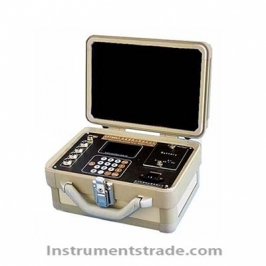
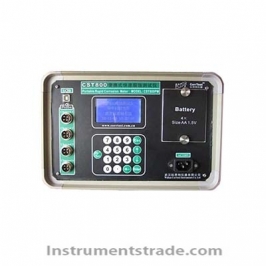
CST1600 Ultrasonic Corrosion Monitor Introduction: The CST1600 ultrasonic corrosion monitoring instrument uses an array ultrasonic probe to measure the corrosion thinning and corrosion rate within a large area of the inner wall of the pipe, and visualizes it in 3D form. The probe adopts non-invasive flexible array ultrasonic sensors, precision time measurement circuits, and temperature compensation circuits, which can overcome the limitations and difficulties of commonly used ultrasonic sensors in measuring curved surface specimens, accurately monitor the internal corrosion thickness and corrosion rate of curved surface specimens such as pipelines or storage tanks, and provide a basis for rapid diagnosis of internal corrosion defects in pipelines. The CST1600 ultrasonic corrosion monitoring instrument uses the time difference of ultrasonic pulse echo to measure material thickness. When ultrasonic waves propagate in a workpiece and encounter contact surfaces between different substances, a portion of the ultrasonic waves will be reflected, while the remaining portion will continue to propagate through the interface. In circuit design, the reflection characteristics of ultrasonic waves are utilized by fixing an ultrasonic composite probe (including transmitter and receiver) on the surface of the tested material. The high-precision time-resolved circuit is used to measure the time difference between the reflection of the ultrasonic emission signal on the inner and outer surfaces, thereby calculating the thickness value of the tested material. It is suitable for determining the internal corrosion thickness and corrosion rate of curved surface specimens such as pipelines or storage tanks. Using CST610 wireless data transceiver, a wireless data monitoring network is formed to achieve remote online corrosion monitoring. The ultrasonic corrosion monitoring instrument series is divided into single channel and multi-channel products, which can be selected according to on-site monitoring needs. Technical parameters: Product model: CST1600 Thickness measurement range: 1~50mm Thickness measurement resolution: 0.01 mm Thickness measurement accuracy: 1% x total thickness ± 0.01mm Ultrasonic frequency: 5 MHz Ultrasonic probe diameter: Ø 8mm Measurement channel: 1, 4, 8, 16 or 32 channels (optional) Storage capacity of 2Mbyte, capable of storing 10000 sets Communication method: RS485, Standard Modbus protocol Power supply method: DC7.2V lithium battery or solar cell power supply Size: Φ 100 × 60mm Weight: 1.5kg Working temperature: -30~+70 ℃ Working humidity: <80% Shell material: Aluminum alloy Protection level: IP66 Explosion proof grade: Ex ia Ⅱ BT4
Introduction: The CST1600 ultrasonic corrosion monitoring instrument uses an array ultrasonic probe to measure the corrosion thinning and corrosion rate within a large area of the inner wall of the pipe, and visualizes it in 3D form. The probe adopts non-invasive flexible array ultrasonic sensors, precision time measurement circuits, and temperature compensation circuits, which can overcome the limitations and difficulties of commonly used ultrasonic sensors in measuring curved surface specimens, accurately monitor the internal corrosion thickness and corrosion rate of curved surface specimens such as pipelines or storage tanks, and provide a basis for rapid diagnosis of internal corrosion defects in pipelines. The CST1600 ultrasonic corrosion monitoring instrument uses the time difference of ultrasonic pulse echo to measure material thickness. When ultrasonic waves propagate in a workpiece and encounter contact surfaces between different substances, a portion of the ultrasonic waves will be reflected, while the remaining portion will continue to propagate through the interface. In circuit design, the reflection characteristics of ultrasonic waves are utilized by fixing an ultrasonic composite probe (including transmitter and receiver) on the surface of the tested material. The high-precision time-resolved circuit is used to measure the time difference between the reflection of the ultrasonic emission signal on the inner and outer surfaces, thereby calculating the thickness value of the tested material. It is suitable for determining the internal corrosion thickness and corrosion rate of curved surface specimens such as pipelines or storage tanks. Using CST610 wireless data transceiver, a wireless data monitoring network is formed to achieve remote online corrosion monitoring. The ultrasonic corrosion monitoring instrument series is divided into single channel and multi-channel products, which can be selected according to on-site monitoring needs.