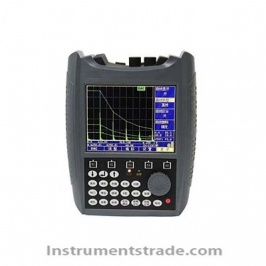
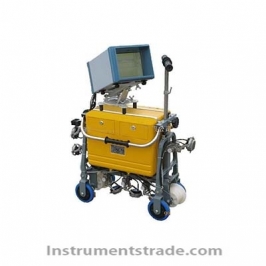
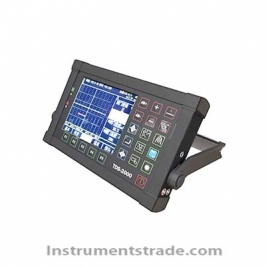
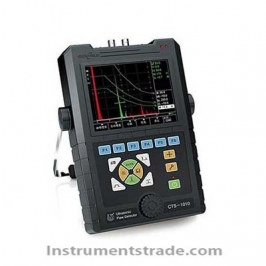
BSN75 Quenching Layer Depth Tester Introduction: The quenching layer depth detector adopts the principle of ultrasonic waves. When ultrasonic waves propagate inside the workpiece, due to the different metallographic structures of the hardened quenching layer and the base material layer, ultrasonic waves will scatter during transmission. By measuring the location of the scattered echo, the thickness of the hardened quenching layer can be determined. This is the principle of the quenching layer depth detector. Technical parameters: Detection range: 40mm Speed range: (100-20000) m/s Repetitive emissivity: 10-10000Hz adjustable Dynamic range: ≥ 38dB Vertical linear error: ≤ 1.5% Horizontal linear error: ≤ 0.2% Resolution:>40dB (5P14) Sensitivity margin:>66dB (200mm deep with 2 flat bottomed holes) Digital suppression: (0-80)%, does not affect linearity and gain Measurement resolution: 0.001mm Repeatability: 0.1mm Gate: inlet gate, outlet gate; Single gate, double gate Alarm: Beep alarm, LED light alarm Power Supply: Direct Current (DC) 9V Battery working time: 15 hours Dimensions: 245 × 150 × 52 (mm) Weight: 1.5kg Environmental temperature: (-20~50) ℃ Relative humidity: (20-95)% RH Pulse amplitude: 100V, 200V, 300V, 400V, 500V graded selection, suitable for a wide range of probes Pulse width: continuously adjusted within the range of (0.03-0.51) µ s to match probes of different frequencies Probe damping: 50 Ω, 100 Ω, 150 Ω, 400 Ω are optional to meet different working requirements for sensitivity and resolution Hardware real-time sampling: high-resolution 12 bit AD converter, sampling speed of 400MHz, high waveform fidelity Detection methods: positive half wave, negative half wave, full wave, RF detection Filter frequency band: (0.2-35) MHz Gate reading: Single gate and double gate reading methods are optional; Peak reading inside the gate Total gain: 120 dB (with 0.1dB, 1dB, 2dB, and 6dB step values) Plug and socket: LEMO01
Introduction: The quenching layer depth detector adopts the principle of ultrasonic waves. When ultrasonic waves propagate inside the workpiece, due to the different metallographic structures of the hardened quenching layer and the base material layer, ultrasonic waves will scatter during transmission. By measuring the location of the scattered echo, the thickness of the hardened quenching layer can be determined. This is the principle of the quenching layer depth detector.